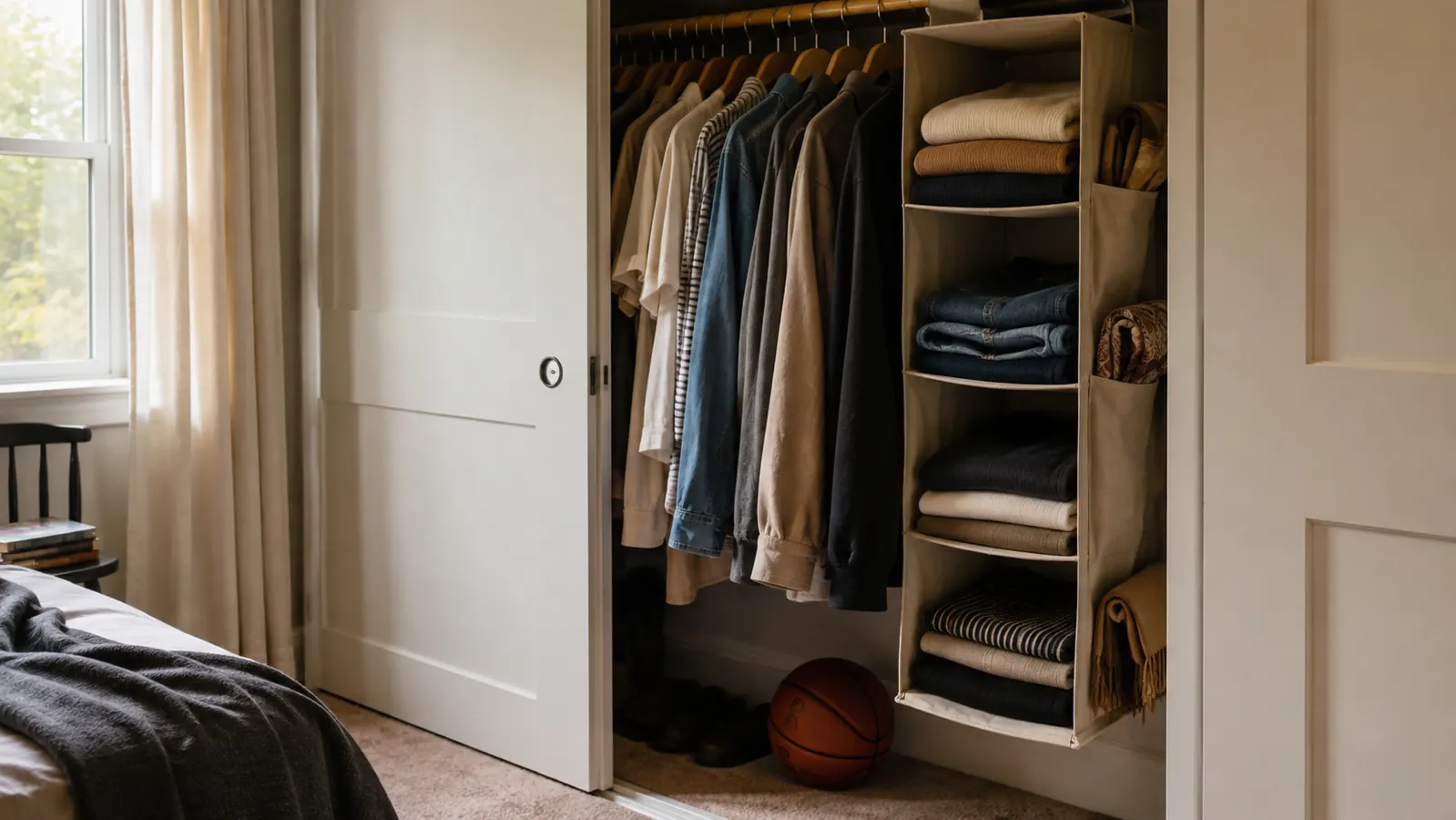
The right end of my closet rod had twelve inches of dead space. Not empty space. Dead space. The kind of gap you walk past for years because you have decided it is too narrow to be worth solving and too awkward to fix. I measured it with a fabric tape in January 2025, ordered the YOUDENOVA hanging closet organizer that same week, and hung it there. That was twenty-one months ago. It is still on the same rod, still holding six shelves of clothes, and I have never once had to rehang it or tighten anything.
Some context, because a closet organizer review without context is a product photo with opinions attached. I am Miriam Sandoval, 54, retired after twenty-six years teaching high school art. Boise, Idaho. A one-story 1960s ranch with exactly one reach-in bedroom closet: six feet wide, sliding doors, one rod, one shelf up top. Ray has the right two feet of that rod and his own plastic hangers. I have the left four. Everything I wear hangs in those four feet, fifty pieces, and the rule since January 2025 has been one in, one out. A bad shelf is not an abstract problem for me.
The Quick Verdict
Six shelves and two side pockets inside twelve inches of rod. Still square and still hanging after twenty-one months. The top shelf dips if you overload it and the fabric wants a vacuum a few times a year.
Amazon Check Today's Price →Twelve inches of rod I had written off as useless
Six shelves, two side pockets, and a 25 pound ceiling I have never come near. It went up in an afternoon in January 2025 and it has not moved since.
Amazon Check Today's Price on Amazon →How I've Used It
I hung it at the right end of my four feet, which puts it against Ray's two feet, and I did that on purpose. The long items live on the left where the rod has room to breathe. The organizer sits where my clothes run short: folded tees, folded knits, jeans. Nothing about putting it up was difficult. It hangs from the rod, it folds flat when it comes down, and it took me longer to decide which shelf got which category than it took to hang the thing.
The order I settled on, top to bottom: tees, light knits, sweaters, jeans, workout clothes, and the bottom shelf holds tomorrow's outfit. That bottom shelf is the part I did not expect to care about. Setting clothes out the night before means my mornings stopped being a negotiation with myself in a dim bedroom at 6:40. By spring 2025 I was getting dressed in about ten minutes instead of twenty, and the bottom shelf is a good part of why.
One thing worth saying plainly: this does not compete with my hangers. The hangers handle everything that hangs, one per piece, the whole rod even and readable. The organizer handles everything that folds. For the first two weeks I kept trying to hang things that should have been folded, out of pure habit, and the shelves sat half empty while the rod stayed jammed. When I moved the knits over, both halves of the closet started working at once.
Depth is the spec I would check first if I were buying again. Twelve inches deep, twelve wide, forty-eight tall. A folded sweater sits down inside a shelf instead of hanging over the front edge. My closet is shallow. Yours probably is too. An organizer that is too deep bulges out through sliding doors and then the doors will not close, and you have solved one problem by creating a worse one. This one stays behind the door line.
What Six Shelves Actually Hold
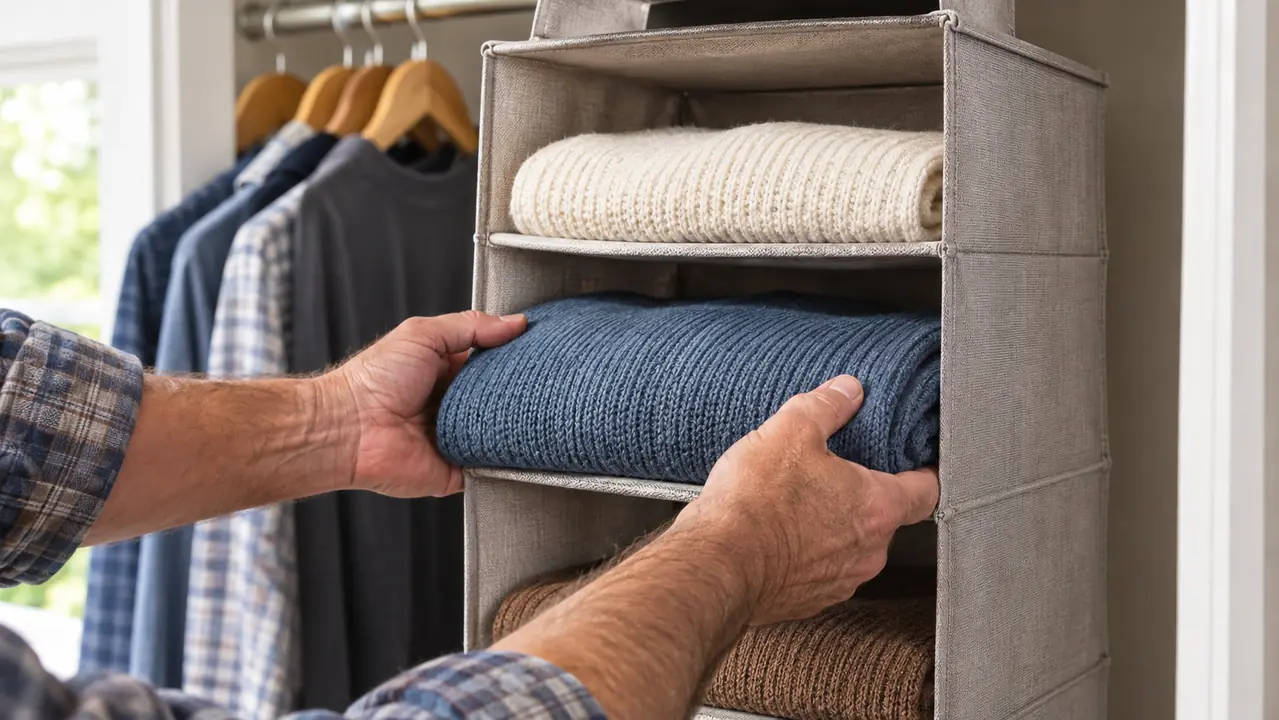
I want to be specific, because holds a lot is not a measurement. My count: the tee shelf takes about ten folded tees. The light knit shelf takes six. The sweater shelf takes four bulky ones or six thin ones. The jeans shelf takes five pairs folded flat. The workout shelf takes four leggings and three tops. The bottom shelf takes one outfit, and on a bad night one outfit plus a second option I will decide between in the morning.
The weight limit is twenty-five pounds and I have never been close. I checked once out of curiosity: five pairs of jeans came to a little under six pounds on the kitchen scale. The sweater shelf is the heaviest spot in my closet and it is not near the number either. The limit is real and I respect it, but fabric shelves give out from uneven loading long before they give out from total weight. That is a habit problem, not a product problem.
What I would not put in it: anything hard and heavy. The listing recommends clothing and towels, and I think that is honest of them. A stack of hardback books or a cast iron pan would be resting on fabric and bamboo, and I would not trust it with either. This is a soft-sided unit for soft goods. That is less a limitation than a description.
The Build: Bamboo Inserts, MDF Panels, and a Weight Limit
This is the part I checked before buying and checked again after a year. Each shelf carries two sturdy bamboo inserts, and the top and bottom are MDF board. That is why the shelves hold a flat rectangle instead of sagging into a hammock, which is exactly what my old fabric shoe hanger did before it gave out. Bamboo is stiffer than the thin plastic sheet you find in cheaper units, and it does not take a set the way plastic does. The YOUDENOVA listing is unusually clear about those inserts, and it was the detail that got my attention.
Twenty-one months in, five of the six shelves are still flat. The top one has a gentle dip in the middle, maybe half an inch, and it is entirely my doing. I went through a stretch in the winter of 2025 when I stacked eight sweaters up there instead of six. Fabric stretched, bamboo bent slightly. When I took two sweaters back off, most of the dip recovered over a couple of weeks. Not all of it. Most of it. A review that tells you every shelf is perfectly flat after two years is a review written by someone who did not look.
The other build note is the fabric itself, and this is the honest complaint. Woven cloth holds dust. Mine lives in a carpeted bedroom closet, so it collects closet dust, and I vacuum it with the brush attachment about every four months. Ten minutes, tops. If you are not going to do that, understand that a fabric organizer will look tired in a year. Mine looks used rather than tired, and the difference is the vacuum.
The Side Pockets and the Shelf That Holds Tomorrow
The side pockets are the reason I stopped losing things. Small cubby spaces on the side of the unit hold the items that are always hard to find, and in my case that is socks and folded scarves. Socks in the pocket, matched, no more digging through a drawer at seven in the morning. Scarves folded into thirds and stacked where I can see the colors. Before this, socks lived in a wad and scarves lived in a bag under the bed, which is a sentence I am not proud to type.
Tomorrow's outfit on the bottom shelf has a second effect I did not plan for. It tells me when I am short on something. If I set out an outfit three nights running and keep reaching past the same four tops, that is information. Something is wrong with those four tops. I have retired two of them this year because the bottom shelf kept quietly refusing to pick them.
What I Liked
- Six shelves inside twelve inches of rod, each with two bamboo inserts so the surface stays flat
- Twelve inches deep, so it sits inside a shallow closet instead of pushing out through sliding doors
- Side pockets hold socks and folded scarves where I can see them
- Rated to 25 pounds, and five pairs of jeans weighed a little under six
- Folds flat and lifts off the rod in seconds when I need the rod space
- Still on the same rod after twenty-one months with nothing to tighten
Where It Falls Short
- The top shelf dips about half an inch if you load it past its habit limit
- Woven fabric collects dust and needs a vacuum every few months
- Soft sided, so it wants clothing and towels rather than anything hard or heavy
- All six shelves are sewn in place and none of them adjust
Five pairs of jeans came to a little under six pounds on the kitchen scale. The shelf has never been the problem. My loading habits have.
What Twenty-One Months Did to It
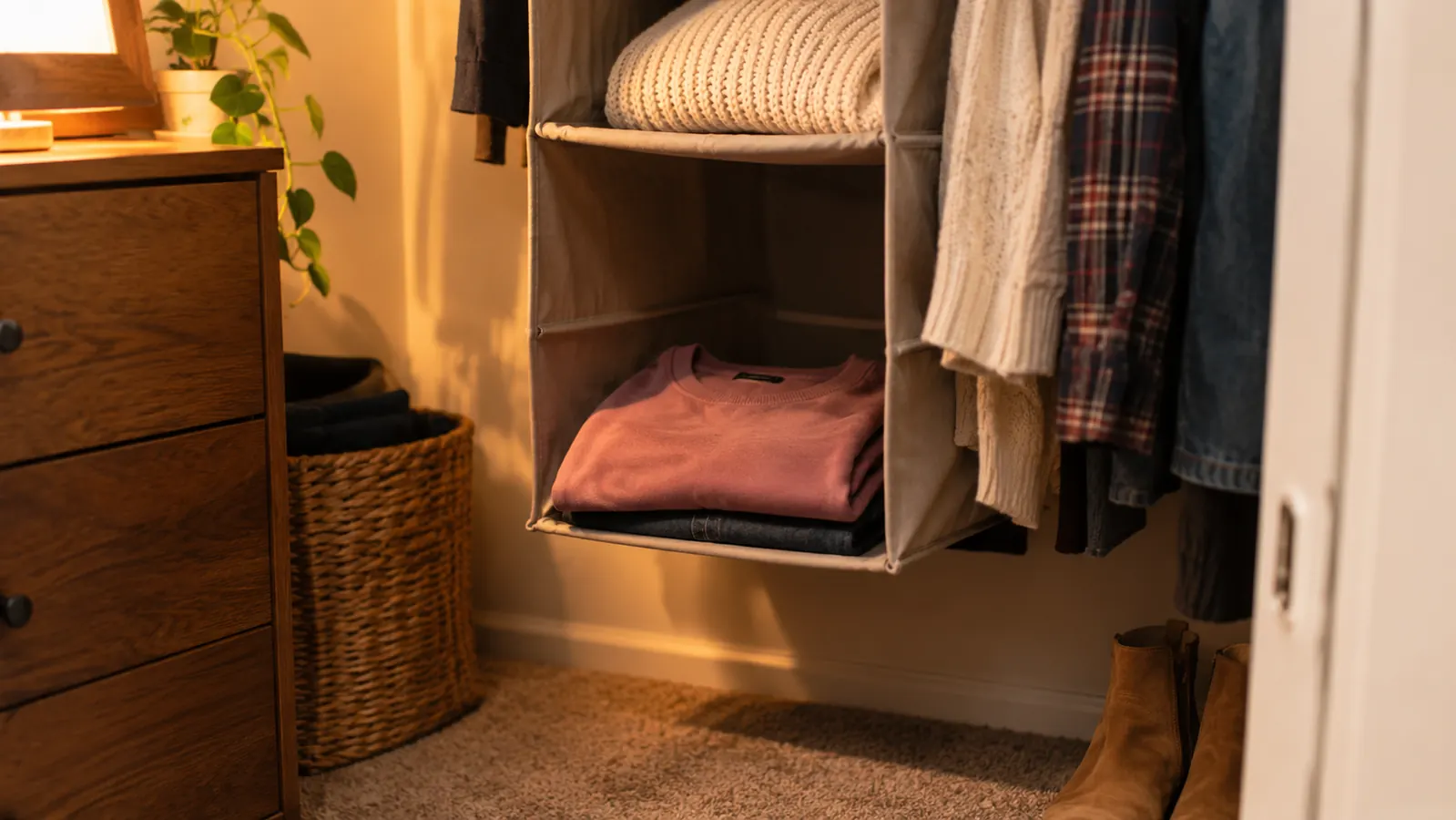
The rod attachment is what would fail first on a cheaper unit. Mine has not slipped or twisted. I check it every season when I pull the under bed bags out for rotation, and there is nothing to check. The seams at the shelf corners are the second candidate and those are intact. What has changed is the color, slightly, along the front edge where the bedroom window hits it. Two years of Boise sun will soften anything. It reads as a quieter grey, not as damage.
I have taken it down twice, both times to wash the closet carpet after I knocked over a bottle of setting spray, and it folded flat and went back up without an argument. Portability is listed as a feature and I can confirm it does what it says. It weighs less than a pound. For something holding five pairs of jeans, that is a strange and satisfying fact.
What I Considered Instead
Before I bought anything I measured for a freestanding shelving tower, because that is what every organizing article suggests. My sister Elena has one in Tucson and she loves it. I measured my closet floor, found the tower's footprint in the listing, and put the pen down. There is no floor space in a six-foot reach-in closet with sliding doors. Ray's shoes are on the floor on his side. My side has a laundry basket and a step stool. A tower would have stood directly in front of the clothes I was trying to organize.
A hanging organizer was the only shape that fit the space I actually had, which was vertical, narrow, and already hanging from a rod. I also looked at the fabric shoe hangers with the flat shelves and rejected them, because they are shallow and the shelves lose their shape under anything heavier than a pair of flats. Bamboo inserts were the deciding detail for me. I have made enough bad purchases in this closet to know when a small specification is doing a lot of work.
Who This Is For
You have a narrow slice of rod doing nothing and a pile of folded clothes with no home. That is the problem this solves, and it solves it inside twelve inches of width. It suits a small reach-in closet, a dorm room, a dressing room corner, or a kid's room where the clothes are small and the shelves are shallow. It suits anyone who folds rather than hangs, because a hanging organizer is a folding tool dressed up as a shelf.
It also suits anyone who sets clothes out the night before, or would like to start. That bottom shelf is not a decorative idea. It is the shelf I use most in the whole closet, and on the mornings when I skipped it the night before, I notice by 7:05. If your closet is one rod and one shelf and nothing else, the YOUDENOVA unit adds six horizontal surfaces without adding one inch of footprint. That is the entire argument.
Who Should Skip It
If nearly everything you wear hangs, skip it. Fifty hangers on a rod do not need six shelves, and you would be trading rod space you use for shelf space you do not. Skip it if you want modular, because all six shelves are sewn in place and none of them move. Skip it if what you need to store is hard or heavy. And skip it if the closet runs damp, because fabric in a damp closet is a bad idea regardless of whose fabric it is.
And skip it if you will not vacuum cloth. I said it earlier and I will say it once more, because it is the one complaint that turns up in every long-term account of anything made of woven fabric. This organizer is low maintenance. It is not no maintenance. Pretending otherwise would be the kind of review that gets a reader to buy something and then quietly resent it for two years.
If you have twelve inches of rod, you have room for six shelves
Mine has been up since January 2025. The fabric wants a vacuum a few times a year and the top shelf wants you to not overload it. Everything else has held.
Amazon Check Today's Price on Amazon →