
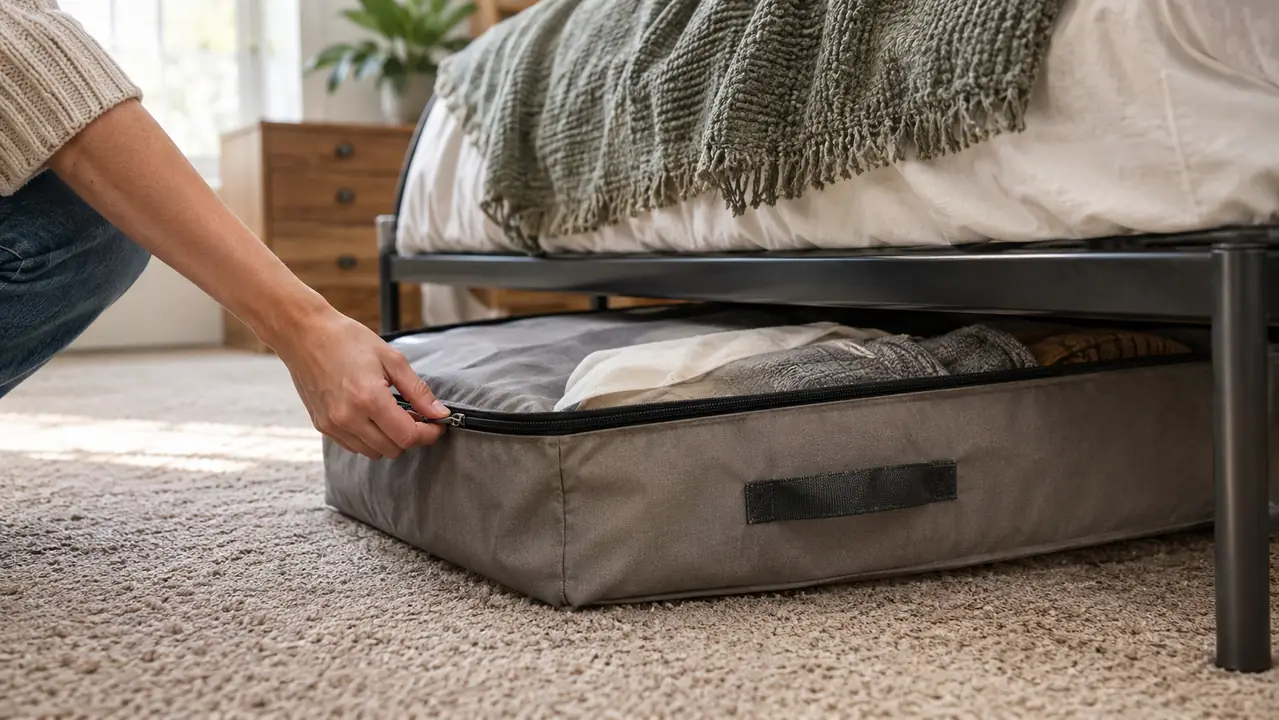
Every April I kneel on the bedroom carpet and haul four flat bags out from under the queen bed. Every October I do the whole thing in reverse. I have made that trip four times now with the Budding Joy under bed storage containers, which means I can tell you what they are like after two years instead of what they are like during the first enthusiastic week. I am 54, I taught high school art for 26 years before I retired in June 2024, and I live in a 1960s ranch house in Boise with one reach-in closet and no basement. Storage here is not a hobby. It is arithmetic.
My closet is six feet wide with sliding doors, one rod and one shelf above it. I have the left four feet of that rod. In January 2025 I cut my hanging clothes to exactly 50 pieces and started a one in, one out rule that has held ever since. That fixed the rod. It did nothing for the sweaters I wear three months a year, the scarves that live in a drawer eleven months out of twelve, or the spare quilt my mother made. The obvious answers were rigid bins, cardboard boxes, or vacuum bags. I had already tried the vacuum bags. The bags that slide under a bed were the third answer, and they are the only one still in my house.
The Quick Verdict
Four soft-sided bags that swallow a season of folded clothes and slide under nine inches of clearance without scraping the frame. Not water resistant, not stackable, and not a substitute for a rigid bin on a damp floor. On dry carpet in a dry house, they have earned their spot.
Amazon Check Today's Price →The pile by the window finally has somewhere to live
Four flat bags, 39 by 20 by 7 inches each, sized for a queen bed with nine inches of clearance. Two per side, twice a year.
Amazon Check Today's Price on Amazon →How I've Used It
I bought the four pack in February 2025 in a single purchase, and I own exactly one set. Four bags under a queen bed on a metal frame with nine inches of clearance, two per side. Bag one and bag two hold off-season clothes. Bag three holds off-season scarves and accessories. Bag four holds the spare quilt. That is the entire system, and I have not added to it or replaced anything in it.
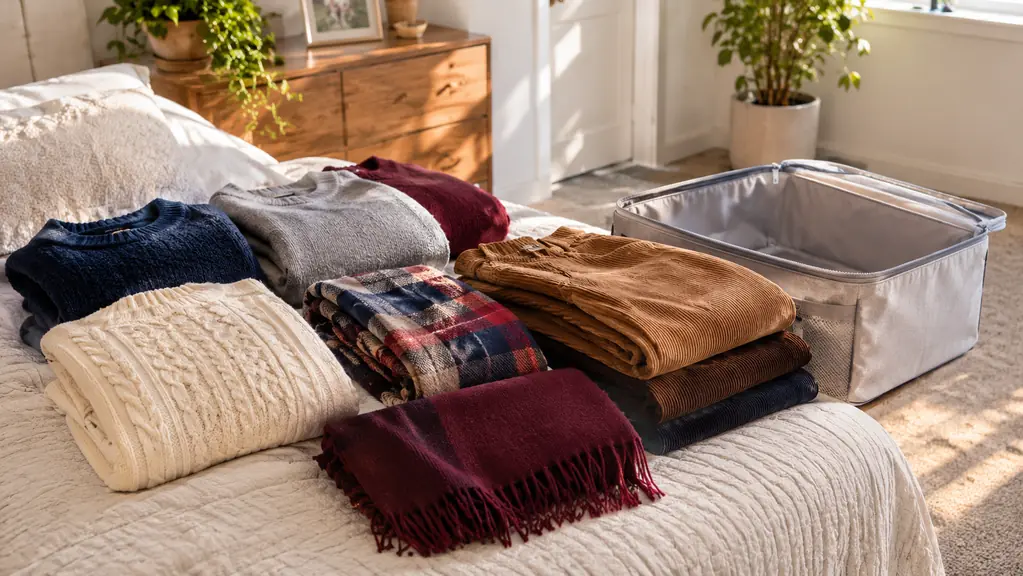
The rotation happens twice a year, in April and October, which is how I arrived at four full cycles: April 2025, October 2025, April 2026, and October 2026. Each cycle every bag comes out, gets unzipped, gets emptied or refilled, gets zipped, and gets slid back under. That is eight loadings and unloadings per bag if you count both directions, and roughly 21 months of sitting on carpet in the dark under a bed.
The first rotation in April 2025 is when the Budding Joy bags proved useful, and I want to be honest about the size of that moment. It was not dramatic. I moved winter sweaters out, put spring things in, and the pile that had lived on the cedar chest by the window since November was gone by dinner. My husband Ray keeps his clothes on the right two feet of the rod on his own plastic hangers and has never touched these bags, which is exactly right. A storage system that works is one you stop noticing.
What Four Rotations Actually Taught Me
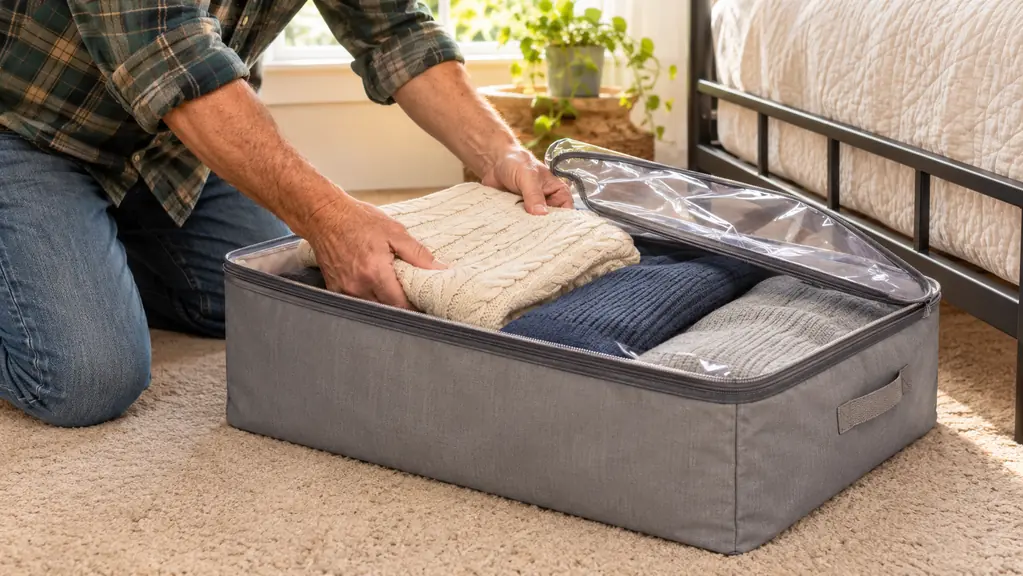
The fabric is a three-ply non-woven, and after 21 months it looks the way it did on arrival except for dust. Nothing has torn at a corner, and the corners are where I grip them to drag them out. The zippers still run their full length. I have pulled these bags across carpet by one end more times than I should admit, and no seam has let go. Non-woven fabric is not canvas, so I expected a split by the second year. It has not come.
The clear top window surprised me. It is a large PVC panel across the top of each bag, and for the first month I ignored it completely. Then in October 2025 I started loading with the window facing up and putting the things I reach for first on top. Now I can kneel beside the bed, look straight through the plastic, and know whether bag three holds the rust scarf or the teal one without unzipping anything. My closet runs cream, camel, olive, rust, teal, brown from left to right, and I think in those colors, so being able to see them matters more to me than it might to you.
The listing calls them foldable, and they are. When I empty one mid-rotation to swap contents, it collapses flat in about ten seconds and stands behind the bedroom door until I refill it. That matters in a house with no basement and no garage shelving to spare. Rigid bins are only useful when they are full. A bag that disappears when it is empty is a different kind of object.
Sizes, Capacity, and the Window I Underused
Each bag is 39 inches long, 20 inches wide and 7 inches deep. The title says 95 liters, and the listing also describes each bag as 90 liters, or 24 gallons. I did not measure in liters and I am not going to pretend I did. What I can tell you is that 39 inches spans the length of my bed frame comfortably, and 7 inches is the number that matters most, because 7 inches is what slides under a bed with 9 inches of clearance without scraping the rail.
Four bags at 16 ounces each is nothing to lift. I carry one at a time from bed to dresser and back, and I have never once felt like I was moving furniture. No assembly is required, which sounds like a line from a brochure until you have spent an evening clicking together a rigid bin and cutting your thumb on the seam.
The rectangular shape earns its keep on carpet. A soft bag that rounds at the edges rocks and rolls when you drag it. A rectangular one tracks straight, which is why I can pull bag four out by one corner while standing up. The material slides across carpet better than I expected it to. It is also not water resistant, and the listing says so plainly, which I respect more than I can tell you. I would rather read a limitation than discover one in March.
What Actually Fits, Bag by Bag
Bag one holds six winter sweaters folded in thirds, and there is room left at the ends. Bag two holds corduroys, flannel shirts, two wool skirts and winter pajamas, and it is the fullest of the four. Bag three holds scarves, gloves, knit hats and a couple of belts, which is a light load for a bag this size but keeps them out of a drawer I was always digging through. Bag four holds the spare quilt, folded to 20 inches wide, and nothing else.
I want to be precise about that fullness, because capacity claims are where reviews go soft. Bag two is packed enough that the zipper takes two hands, one to hold the top flat and one to pull. It closes, but it does not glide. If you fold loosely or pack bulky knits, you will fill these faster than the liter count implies. Fold with intention and each bag holds a real season of clothes for one person.
Since I cut my hanging clothes to 50 pieces, everything in these bags is genuinely off-season, which is the only reason four bags is enough. If you keep all four seasons on the rod and in the bags at once, you need more bags, and this set will feel small. The product is fine. The math is just the math.
Where They Fall Short
Three real complaints, and none of them is a deal breaker for me.
First, they are not water resistant. Not slightly, not mostly. The listing says not water resistant and my bedroom carpet has never been damp, so it has never mattered here. If your bedroom is a converted basement, or the floor by the bed sweats in summer, these are the wrong object and a rigid bin with a sealing lid is the right one. I would not talk you into these for a humid room.
Second, soft sided means no stacking. If you were picturing two bags piled on top of each other to double your space, you cannot. They go side by side on the floor and that is it. My queen bed fits two per side and that is exactly the capacity I have, so the limit landed where I needed it to. A twin bed would give you far less.
Third, dust. Non-woven fabric sitting on carpet under a bed collects it. Every rotation I wipe the tops with a damp cloth before they go back under, which is about thirty seconds a bag and twice a year. I mention it because nobody mentions it, and because the window that makes them useful is also the surface that shows every speck.
What I Gave Up to Use Them
Before these, my off-season clothes lived in vacuum bags in the hall closet. I used one set for a single winter, 2023 into 2024, and then I stopped. They compressed beautifully, and that was the problem. My sweaters came out creased along the fold lines and stayed creased after a day on hangers, and I am not willing to steam a cardigan every October to save four inches. Vacuum bags are not a bad product. They were the wrong product for knits.
I also considered rigid plastic bins and did not buy them. The ones I looked at were deeper than 7 inches and would have scraped my bed frame on the way in. That is the whole reason the flat profile of the Budding Joy bags won: they are the depth that fits, not the depth that holds the most. My sister Elena in Tucson has a freestanding closet tower, and I measured for one and rejected it because it would not fit my closet at all. Different closet, different answer.
The thing I did not give up was the ability to check a bag without unpacking it. The window does that, and after four rotations I would pay attention to that feature if I were buying again.
What I Liked
- Slides under a bed with 9 inches of clearance without scraping the frame at 7 inches deep
- 39 by 20 inches holds a full off-season season of folded clothes for one person
- Clear top window lets you identify contents without unzipping anything
- Zippers still run and no corner seam has torn after four rotations and 21 months
- Folds flat when empty and weighs 16 ounces, so one person moves it easily
- No assembly required, straight out of the package and under the bed
Where It Falls Short
- Not water resistant, so a damp floor or humid room rules them out
- Soft sided and cannot be stacked, only laid side by side
- Non-woven fabric collects dust on carpet and needs a wipe each rotation
- A full bag takes two hands to zip, and bag two is right at that limit
Nothing has torn, nothing has gone musty, and nothing has been lost in 21 months of loading and unloading. On dry carpet in a dry house, that is the entire case for them.
Who This Is For
This set is for someone with a bed on a frame with real clearance underneath, a dry bedroom floor, and a genuine off-season pile that has nowhere to go. It suits a person who rotates clothes twice a year and wants the rotation to take twenty minutes instead of an afternoon. It suits anyone whose closet has one rod and one shelf, the way mine does, and who has already accepted that the closet is finished and the floor is the remaining space. The Budding Joy bags also suit a renter, because they weigh nothing, fold flat, and move in a car trunk without a dolly.
If you have a queen or king bed and a carpeted bedroom in a house that stays dry, four bags is a sensible unit. Two per side, contents visible from above, twice a year of your attention. That is the entire relationship.
Who Should Skip It
Skip these if your bedroom is below grade, if the floor near the bed ever feels damp, or if you have had a leak under a bed before. Not water resistant is a plain statement and I would take it at face value. Skip them if you need to stack, because you cannot, and if you need to store something heavy enough to break a zipper, because a soft bag will not hold a stack of hardcovers or a tool case.
Skip them if your bed sits low, under about six inches of clearance, since a 7 inch bag will not slide under and you will be dragging it out at an angle every time. Skip them if you want to see your storage. These live in the dark under a bed and look like nothing, which I like and you may not. And skip them if you are looking for a single bag. This is a four pack, and while four is the right number for a queen bed and one person's off-season clothes, it is too many for a twin bed in a small room.
Nine inches of clearance and a dry floor is all these ask for
Four flat bags, two per side, twice a year, and the pile on the cedar chest is gone. Check the current price and the exact dimensions before you buy.
Amazon Check Today's Price on Amazon →