
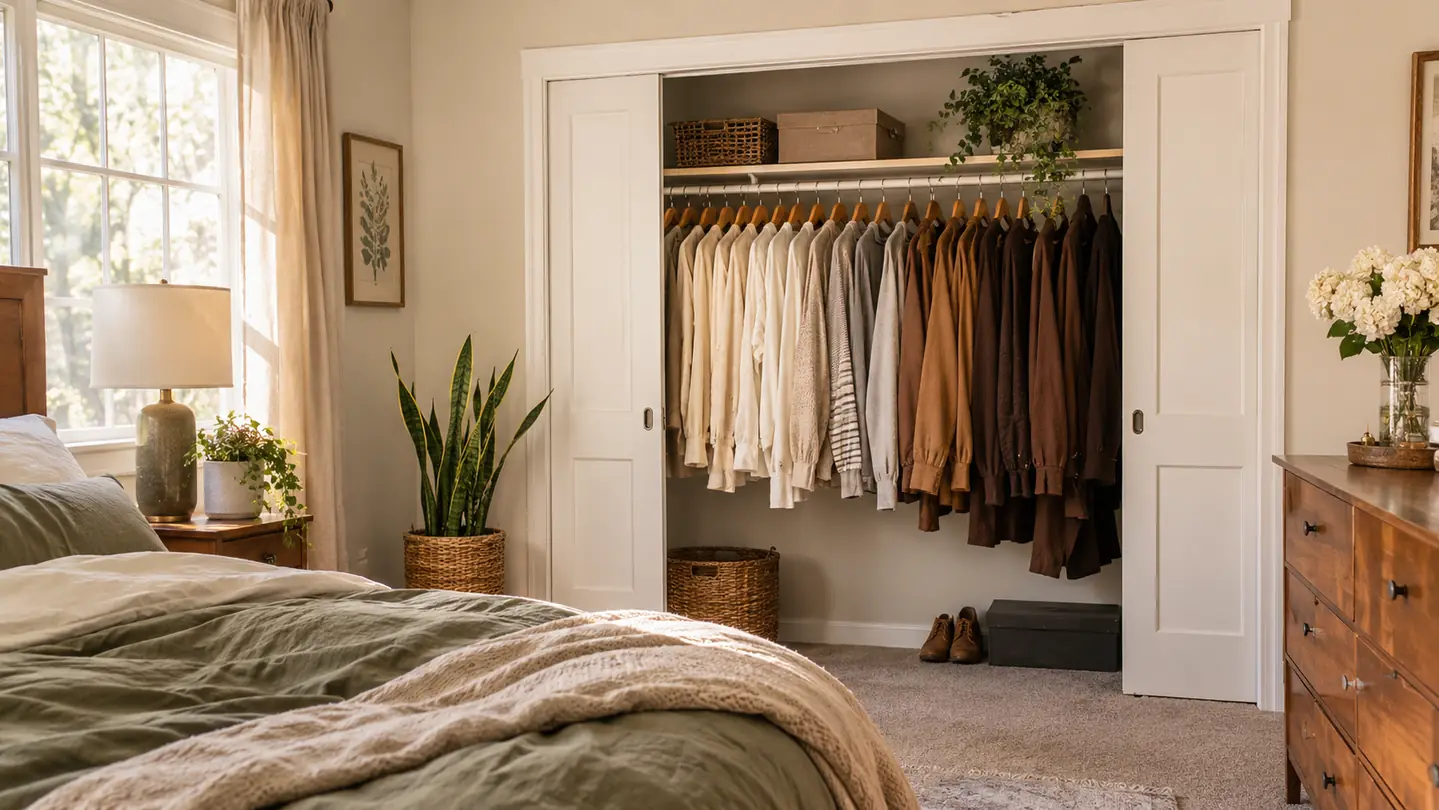
My closet is six feet wide with sliding doors, one rod, and one shelf above it. For about twenty years it was a place where clothes went to be forgotten. I would stand there at seven in the morning sliding hangers back and forth, and then put on one of the same three things I always wore. The problem was never that I had nothing. The problem was that I could not see what I had.
In January 2025, the week after the holidays, I took every stitch of clothing out of that closet and cut my hanging pieces down to exactly fifty. Then I bought one fifty pack of ZOBER velvet hangers and hung all fifty pieces, one per hanger. The rod looked even the same day and nothing slid off it. What took another three weekends, and what actually changed my mornings, was the color. Here is the sequence I landed on, step by step, including the two things I did wrong first.
Fifty pieces, fifty hangers, one rod that finally looks even
The fifty pack is what made the sorting possible, because I stopped running out of hangers halfway through and improvising. Slim velvet profile, notched shoulders, hooks that turn a full circle.
Amazon Check Today's Price on Amazon →Step 1: Take Everything Off the Rod and Sort by Season First
Not by garment type. That was my first mistake. I started by making tidy piles of shirts and skirts and sweaters, and by the end of the afternoon I had eight beautiful piles and no idea what to do with any of them. Type is how a store organizes itself. Season is how you actually live.
So everything came off the rod and went onto the bed in two groups: wears now, and wears in three months. Boise gives us a real summer and a real winter with two long shoulders in between, so I ended up with four working groups, not two. If you live somewhere with one mild season, your groups will be thinner and the whole job will go faster.
Then count. I counted twice because I did not believe the first number. I was at 118 hanging pieces in a six-foot closet, which is why it never worked. Fifty was the number I chose, and the rule since then has been one in, one out. A number you can hold in your head is worth more than a system you admire.

Step 2: Pick a Color Order You Can Recite Without Looking
In spring of 2024 a color analyst draped me and told me I was a soft autumn. I am not going to pretend I understood it at the time, but I wrote down the palette and it turned out to be the most useful list in my house: cream, camel, olive, rust, teal, brown. That is the order, left to right, and it has not changed since.
A fixed sequence beats light to dark, and it beats sorting by garment type, because light to dark requires you to judge value every single time you hang something up. Judging is work. Reciting is not. My sequence goes from my palest neutral to my deepest, which happens to also run light to dark, but I do not have to think about it that way. I just say the six words in my head and put the hanger where it belongs.
Whatever sequence you choose, choose one you can say out loud in under four seconds. If you need a chart taped inside the door, the sequence is too complicated and you will abandon it by March. And if there is a second person on the rod, leave their two feet alone. My husband Ray keeps his clothes on his own plastic hangers on the right side, and I have never once reorganized them. That is the price of a peaceful house.
Step 3: Put Every Piece on the Same Hanger Before You Hang a Single Thing
This is the step people skip and it is the one that makes the color work. When hangers are a mix of wire and thick tubular plastic, no two garments hang at the same height, the shoulders droop at different angles, and the color blocks look ragged no matter how carefully you sort. The ZOBER hangers are slim velvet with a 17 inch width and a 9.25 inch height, notched shoulders, and hooks that swivel a full 360 degrees. Fifty of them filled the rod with room left over. There is also a connected horizontal bar across the bottom, so a pair of trousers can drape over it instead of being folded across the shoulders, which is the sort of small thing you notice around month six.
The velvet grip is the part that surprised me. The listing says each hanger holds up to about 4.5 kg, roughly ten pounds, and I have hung heavy winter weight trousers without any bending. What I did not expect was the other direction: the grip is strong enough that a slippery satin blouse will not settle into place on its own. You need two hands, one to hold the hanger steady and one to guide the fabric onto the shoulders. It is a small tax and I pay it happily, because it is the same grip that keeps a wide neckline from sliding off overnight.
Two flaws, honestly. In the first week I found a faint black fuzz on one white shirt, and then never again. And I keep my heavy coats in the hall closet where they have always lived, so I cannot tell you how these handle a parka. After twenty-two months of daily use, not one hanger has broken, which is more than I could say for the plastic ones they replaced.
Step 4: Hang Left to Right in Your Sequence, With a Gap Between Seasons
Within each color, order by how often you wear the thing. The most-worn piece goes at the left edge of its color block, where your hand lands first. That single habit did more for my mornings than the color did, because it means the decision is already made before I am fully awake.
Between seasons, leave a gap. Mine is about the width of my hand. It costs me four inches of rod and it gives my eye a place to stop. As an art teacher I spent twenty-six years telling teenagers that white space is not empty space, and it took me two decades to apply my own lesson to a closet. When there is no gap, the whole rod reads as one long gray blur and you are back to sliding hangers.
Here is why I think the ZOBER hangers matter to this particular step more than they matter to hanging. Because every single one is identical, a color block keeps one clean silhouette from end to end. A wire hanger next to a plastic tube hanger breaks that line even when the garments are sorted perfectly, and my eye catches it from across the room every time. Sameness is the whole trick.
Stand back when you are done. Not to admire it, to check it. If a block looks wrong, it usually is one garment out of place, and you will spot it in three seconds from six feet away. That is the entire point of coding by color: your eye does the finding, so your brain does not have to.
Step 5: Swap the Rack Twice a Year and Store the Rest Under the Bed
I rotate in April and October. It is written on the calendar, not left to mood. April 2025 was the first rotation and it was the one that convinced me the whole system would hold, because pulling the cold-weather pieces out and dropping the warm-weather ones in took under an hour.
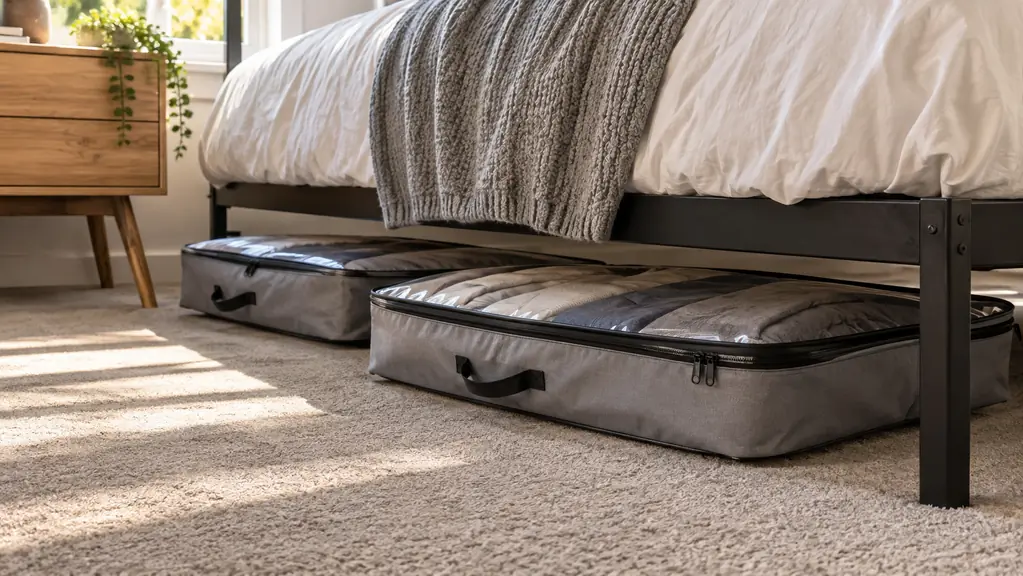
Four flat fabric bags live under the queen bed, two per side, on a metal frame with about nine inches of clearance. Each bag is roughly 39 by 20 by 7 inches, soft sided, with a clear window on top and a zipper. Bag one and bag two hold off-season clothes, bag three holds off-season scarves and accessories, and bag four holds a spare quilt. The clear window matters more than I expected, because I can read what is inside without unzipping anything. I have done four rotations now and nothing has gone missing.
Moving a piece in or out of rotation takes about ten seconds, because the garment comes off its ZOBER hanger at the rod and goes straight onto the bed, and the hanger stays where it belongs. That sounds trivial until you have done it fifty times in an afternoon. The bags themselves are not water resistant, they are soft sided so they do not stack, and they collect some dust on the carpet. I am fine with all three because they slide out with one hand. Before these I tried vacuum bags for a single winter and stopped, because my sweaters came out creased across the middle and never really relaxed.
Fifty pieces, fifty hangers, four rotations in. Getting dressed went from about twenty minutes to about ten, and the only thing that changed was that I could finally see the rod.
Two Mistakes I Made So You Do Not Have To
The first was sorting by type before sorting by season. If you make eight tidy piles of shirts and skirts you will feel productive for about two hours and then stall completely. Season first, always.
The second was buying hangers before counting clothes. I nearly ordered a hundred when I had 118 pieces that needed to become fifty. Count first, then buy, then hang. In that order.
There is a third one I am still working on, which is keeping clothes that fit a life I no longer have. A retired teacher does not need four blazers. The one-in, one-out rule handles this better than willpower does, because it makes the decision small and immediate instead of large and emotional.
What Else Helps
Color coding the rod only solves the half of the closet you can see. The rest of it needed somewhere to live. A grey six-shelf hanging organizer sits at the right end of my four feet of rod, about twelve inches wide, and it took over everything that does not belong on a hanger: tees at the top, then light knits, sweaters, jeans, workout clothes, and the bottom shelf reserved for tomorrow's outfit, set out the night before. I stay well under its weight limit. The top shelf sags a little if I overload it, and the fabric gathers dust, but it has earned its space. My sister Elena has a freestanding shelving tower in Tucson. I measured for one here and it would not have fit, so if your closet is narrow, measure before you fall in love.
On the vanity, a clear seven-drawer makeup organizer ended the era of the shoebox and the cracked plastic caddy. Three wide drawers hold palettes, then blush and powders, then brushes laid flat. The four small drawers hold lipsticks, liners, mascara and samples. Tall foundation bottles do not fit the small drawers, so they stand on top next to the setting spray. It shows every fingerprint and the small drawers are shallow, but I can see every shade I own and that was the whole goal.
Jewelry went to a black two-sided hanging organizer on a hook on the back of the bedroom door, size large, holding 28 necklaces, 14 pairs of earrings and 9 rings, most of them warm gold tone. It swings when the door opens and a heavy necklace will pull one side down, but I have not untangled a chain since. My mother's wooden jewelry box stays on the dresser with three heirloom pieces inside it, and nothing else.
Start with the rod, because the rod is what you see first
One fifty pack covers a fifty-piece closet exactly, one hanger per piece, with nothing left over and nothing improvised. That is how the sorting actually finishes.
Amazon Check Today's Price on Amazon →