
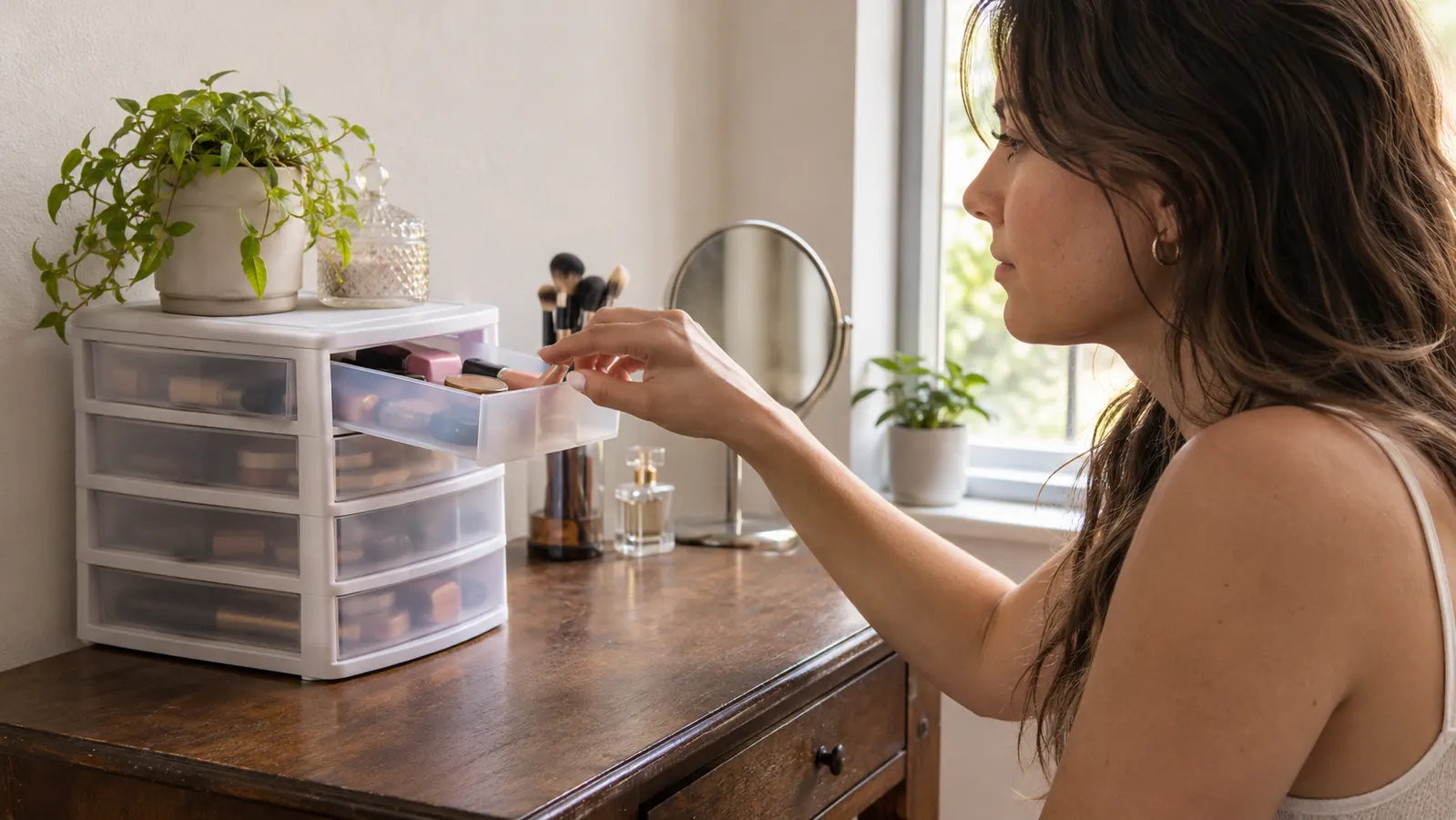
For eleven years my makeup lived in a shoebox. Not a good shoebox, either. A running shoe box with one corner crushed, and inside it a cracked plastic caddy that had lost two of its dividers, so the mascara and the eyeliner rolled around together like loose change. Every single morning I dumped the whole thing onto the bed, dug out the one brown shadow I actually wanted, and put everything back. That is not organizing. That is a small archaeological dig you perform before breakfast, and I did it for over a decade without once asking why.
In March 2025 I bought a Sorbus 7-drawer makeup organizer and set it on the left side of my desk. That is the entire origin story. No label maker, no plan drawn on graph paper, no system with a name. I moved the shoebox contents into drawers over one weekend, and by the following Wednesday I was getting through my face in noticeably less time. I have used it about twenty months now, through one very hot Boise summer and two visits from my sister, and I have not once wished I had bought something fancier.
One honest note before the steps. This is a plastic box with seven drawers, and it is not furniture. It will not fix a collection that has genuinely outgrown the space, and it will not make you want to put things away. What it does is put every shade in front of your eyes at the same time, which turns out to be the part that actually saves you time in the morning. Everything below is what I did, in the order I did it, including the mistakes.
Before you sort a single lipstick, give it somewhere to land
Seven drawers, three wide and four small, about 9.5 inches wide by 6.5 deep by 11 tall. Small enough for a desk, big enough to see every shade at once.
Amazon Check Today's Price on Amazon →Step 1: Empty Everything Onto a White Towel
Pick a Saturday morning and take it all out. Not the makeup you use. Everything. The sample sachets from the department store, the lip gloss that lives in the bottom of your purse, the eyeshadow you bought for a wedding years ago. Spread a white towel across the bed and work in daylight if the window allows it. A white towel gives you a true read on color, which matters more than you would think, and it also means a dropped powder compact does not stain the quilt.
Then sort into four piles and be strict about it: keep, finished, duplicate, and give away. The duplicate pile is always larger than you expect. When I emptied my shoebox I found three opened mascaras, two identical brown eyeliners, and a foundation in a shade that had never once matched my face. Two of those mascaras were dry as a bone. The eyeliners were the same pencil bought twice, months apart, because I could not see what I already owned.
Anything with a changed smell, a separated texture, or a crusted cap goes into the finished pile. I am not a dermatologist and I am not going to lecture you about your own skin. I will tell you that I retired more than half of what came out of that shoebox, and I have not missed a single item since. That is the test I use now: if I cannot remember owning it, I was not using it.
Step 2: Measure the Spot Before You Buy Anything
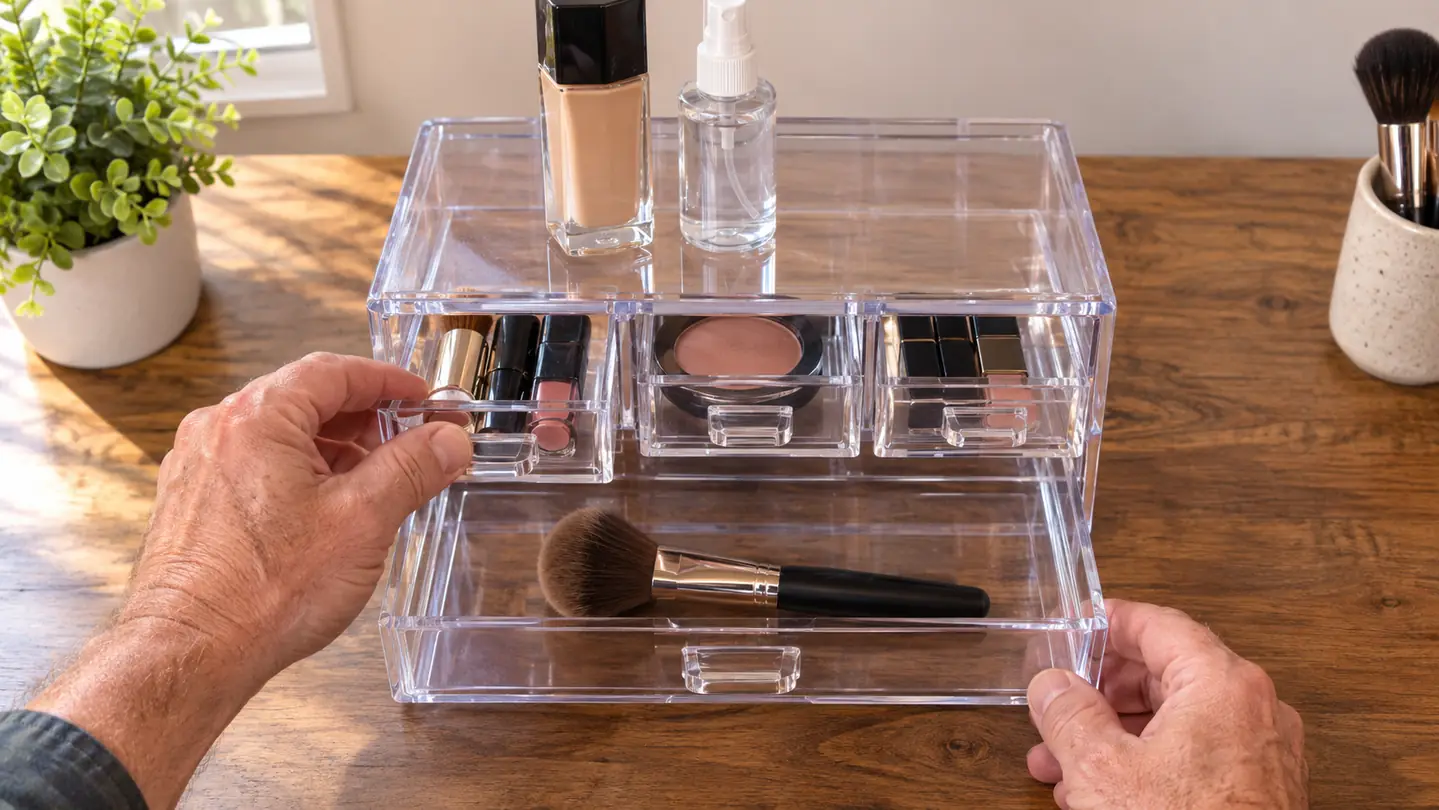
Before a container comes home, measure the surface. I used a fabric tape on my desk because a metal tape measure kept snapping back and taking skin with it. I wanted the organizer on the left, my mirror on the right, and enough clear space in the middle to set down a coffee cup. The Sorbus is about 9.5 inches wide, 6.5 inches deep and 11 inches tall, and it weighs a touch over four pounds, so it is easy to slide when you want to dust under it.
Two measurements matter more than the footprint. The first is height. Eleven inches is the height of the box itself, not the height of the box with your foundation standing on top of it. If you plan to stand bottles up there, and you probably will, add another five or six inches of clearance. My desk sits by the bedroom window and the sill is high enough that a bottle on top clears it comfortably. On a lower shelf or a tight counter, it would not.
The second is depth, and this is where a drawer organizer earns a place on a desk instead of a shelf. At 6.5 inches deep it does not crowd the writing space. If your vanity is shallow, put a ruler down and check before you order, because a deeper unit will hang over the front edge and then every drawer fights you. I measured twice and still left myself about an inch of margin, which is the only reason the mirror frame fits.
Step 3: Sort by Shape, Not by Brand
The Sorbus has seven drawers and they are not all the same. Three are wide and run nearly the full width of the unit. Four are small and sit side by side in the upper section. Sort by the shape of the object, not by brand and not by whatever category is printed on the packaging. This one decision did more for me than any label I could have written.
My wide drawers, top to bottom: eyeshadow palettes in the top one, blush and powder compacts in the middle, brushes laid flat in the bottom. Palettes and compacts are wide and flat, so a wide drawer holds them without stacking and without hiding the shade underneath. That was the whole point for me. For years I owned a teal shadow I never wore because it sat buried beneath a bronzer, and I had convinced myself I did not like teal.
The four small drawers take the narrow things: lipsticks, liners, mascara, and the samples. They are shallow, and that is the one limitation I would mention to a friend before she bought one. A liner has to lie flat. A mascara tube has to lie flat. Nothing stands upright in them except a lipstick, and even that is snug once there are six in a row. It is a plastic organizer, so it stays organized only if you respect the height it gives you.
Step 4: Leave the Top Surface for What Will Not Fit Inside
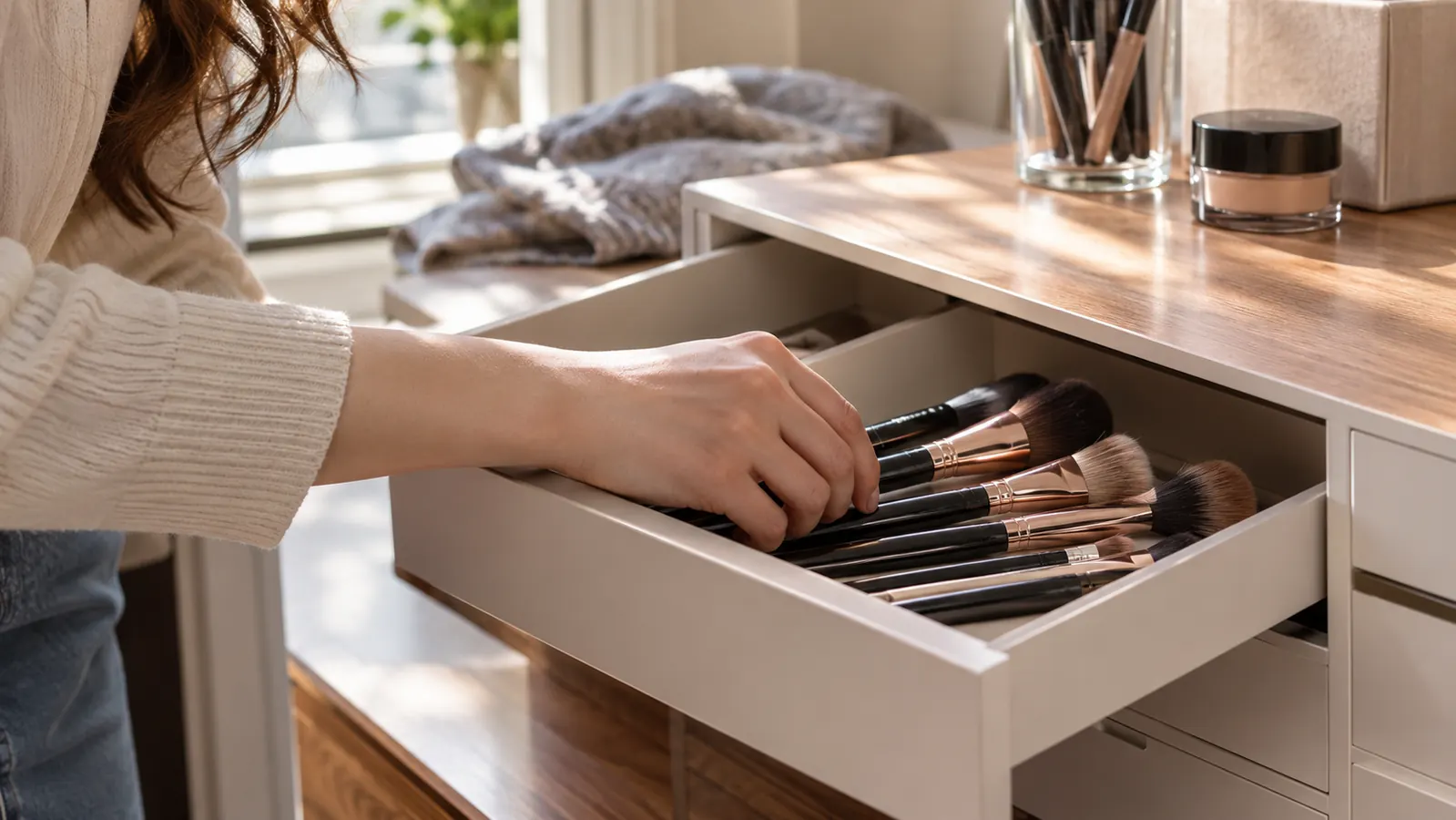
Everything that will not go in a drawer lives on top, and the trick is deciding what that is before anything else migrates up there. For me it is the tall foundation bottles and the setting spray, standing at the back, and nothing else. The top is roughly 9.5 by 6.5 inches and a bottle eats more of that than you would guess. Once three are standing there the surface reads as full, and nobody in this house is tempted to balance a hairbrush on it.
Brushes go in the bottom wide drawer, laid flat and pointed in one direction. I keep face brushes on the left and eye brushes on the right, which is a habit from twenty-six years of setting out supplies before a class. Laid flat they stay cleaner and they do not splay at the tip, and I can see at a glance which ones have gone too long without a wash, because the ones at the front are the ones I reach for.
One firm rule: do not put jewelry in this organizer. The drawers are sized for cosmetics, the plastic will scratch if you drop a chunky bracelet into a small drawer, and rings slide under the lipsticks where you will not find them for a month. My makeup organizer holds makeup and nothing else. My jewelry hangs elsewhere and always has, and the two have never once tried to swap jobs.
Step 5: Do a Monthly Reset and Wipe the Fronts
On the first Sunday of the month I open all seven drawers and look inside. Not a deep clean. Just a look. Something has always drifted. A lipstick bought on a Tuesday ends up in the sample drawer, which is the wrong place for it, and it needs to go back with the other lipsticks or it will never get worn again. The reset takes about four minutes and it is the reason the system has held for twenty months instead of six weeks.
The surfaces want a wipe more often than you would expect. The material shows dust and it shows fingerprints, especially on the drawer fronts where your hands go every morning, and a fine haze of powder settles on the top. A dry microfiber cloth once a week takes twenty seconds and keeps the whole thing from looking tired. I have never dropped mine and I have never cracked a drawer, but it is plastic and I handle it like plastic, pulling the small drawers straight out rather than at an angle.
Leave the small drawers underfilled. They are shallow, and a shallow drawer packed tight is a drawer you stop opening, which puts you right back in the shoebox. Two thirds full is the limit I use, with a little air at the front so a fingertip can get in and lift out a liner. When a drawer starts to resist, that is the signal that something in it needs to leave, not the signal that you need a bigger box.
Seven drawers did not make me buy less makeup. It made me stop buying the same brown eyeliner twice, because for the first time I could see the one I already owned.
What Else Helps
The organizer solves the makeup. It does not solve the light, and light is what I notice first after twenty-six years of teaching art. My desk sits by the bedroom window for a reason: I check a foundation shade in daylight or I do not check it at all. A drawer set under a warm bulb will have you buying the wrong shade with enormous confidence, and then blaming the drawer for hiding the right one.
It also does not solve having too much. If seven drawers fill up and start to bulge, the answer is not a second organizer or a stack of them, and it is not a bigger unit. The answer is another sorting afternoon with the white towel. I have run the same rule on my makeup that I run on my closet, one in and one out, and it has held since the spring of 2025 without much drama. The container is a tool. The rule is the system.
What it replaced matters too, and I want to be blunt about this part. Mine replaced a shoebox and a cracked plastic caddy, and both went out with the recycling the same week. If you keep the old container just in case, you will have filled it again inside a month, and then you will have two problems instead of one. Whatever you were using before, let it go. That was the step I almost skipped, and it is the one I would repeat first.
Twenty months in, not one drawer has jammed
Three wide drawers for palettes and brushes, four small ones for lipsticks, liners and mascara, and a flat top for the tall bottles that will not go inside. It is the plainest thing on my desk and the only one I use every day.
Amazon Check Today's Price on Amazon →