I spent years organizing my jewelry the way a store does, which is to say by type. All the earrings in one tray, all the necklaces on one hook, all the rings pressed into a little velvet slot. It looked orderly and it was useless. On a Tuesday morning I do not want to browse my entire collection. I want the earrings that go with the olive shirt, and I want them in ten seconds, because I am standing in front of a six-foot closet with the door half open and my husband Ray is already in the kitchen with the coffee. That is the whole problem in one sentence: jewelry sorted by category makes you shop. Jewelry sorted by outfit lets you get dressed.
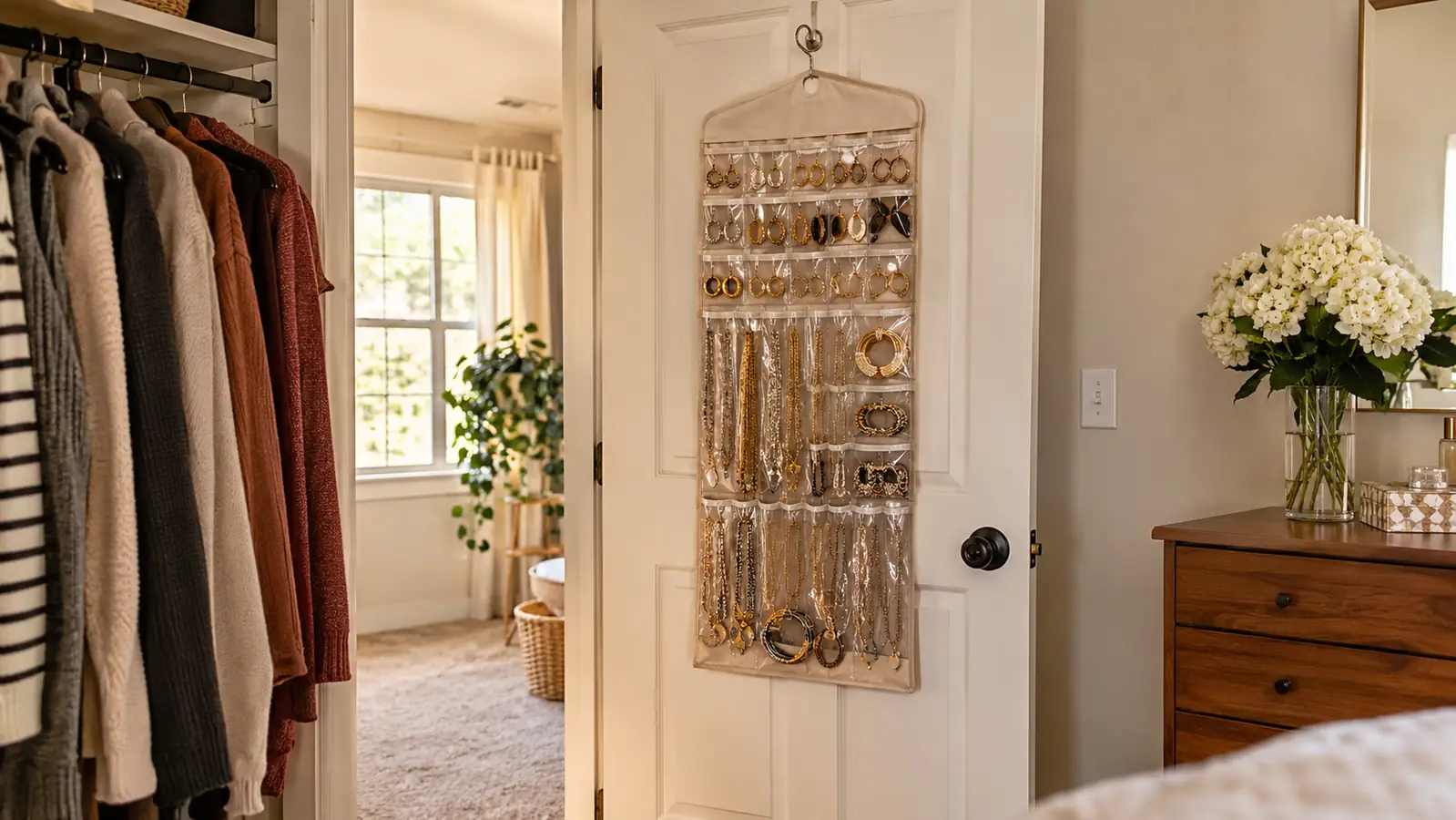
The thing that made the switch possible was a BAGSMART hanging jewelry organizer, the size L two-sided one, on a hook on the back of my bedroom door. I bought it in April 2025, about nineteen months ago, well after the closet clean-out had already started. It holds 28 necklaces, 14 pairs of earrings and 9 rings for me, nearly all of it warm gold tone, and the rest went to my sister Elena in Tucson. But the organizer is not the method. It is the surface the method needs. Here is how I actually did it, in five steps, in case your dresser looks the way mine did.
The one surface this whole method hangs on
BAGSMART makes the size L two-sided organizer I keep on the back of my bedroom door: three rows of wave-shaped metal hooks listed for up to 42 necklaces, a hanger that rotates, and a panel that folds flat. Nineteen months in, mine is still on the same hook.
Amazon Check Today's Price on Amazon →Step 1: Empty Everything Onto the Bed and Sort by Outfit, Not by Type
Clear the top of the bed. I have a queen bed on a metal frame with nine inches of clearance underneath, and that clearance matters later, but for now the mattress is your sorting table. Bring the wooden box, the saucer from the bathroom counter, the corner of the drawer where the broken chains live, the good earrings you keep by the sink. All of it goes on the bedspread. This takes about twenty minutes and it is worse before it is better.
Now the part that is different. Do not make a pile of earrings and a pile of necklaces. Make piles of outfits. I laid out the six combinations I actually leave the house in: the camel trousers with the cream knit, the olive shirt with the brown belt, the rust dress, the teal top with jeans, and the two dressed-up outfits I wear maybe four times a year. Then I put each piece of jewelry down on the outfit it belonged to. The amber beads went on the rust dress. The thin gold chain went with the cream knit. The hoops went with everything, which is its own category and needs its own place.
Anything left over when you finish is your answer. If a piece does not sit on a single outfit you actually wear, it is not jewelry you own, it is jewelry you store. Mine went three places: a small envelope for Elena, a donation bag, and my mother's wooden box on the dresser, which now holds exactly three heirloom pieces and nothing else. That box is not for outfits. It is for her. Keeping those two jobs separate is the reason the rest of this system holds.
Step 2: Put the Closet in Color Order First, Because the Jewelry Has to Match Something
A color analyst draped me in spring 2024 and told me I am a soft autumn. I am fifty-four years old and I had been wearing the wrong colors for three decades, so I took it seriously. My closet now runs left to right in one fixed order: cream, camel, olive, rust, teal, brown. Six families, no exceptions, fifty hanging pieces, one in and one out since January 2025. When I open those sliding doors I am not choosing from a hundred options. I am choosing from six.
The jewelry has to match that order or the whole thing falls apart. Once the rod was sorted, I could walk it from left to right and see which metals did the work. For me it is warm gold tone, nearly all of it. Silver looked tired next to the olive and the camel and I stopped reaching for it. I am not going to tell you warm gold is correct for you. I am telling you to walk your own rod in whatever order it sits and let it tell you.
One practical note about placement. My BAGSMART organizer hangs on a hook on the back of the bedroom door, and that door sits at the left end of the closet, right beside the cream and the camel. That was luck when I hung it, not planning, but I would plan it if I did it again. You want the organizer within arm's reach of the section of the rod you wear most, because the two-minute version of getting dressed only works when both things are in the same place.
Step 3: Give Each Side of the Organizer a Different Job
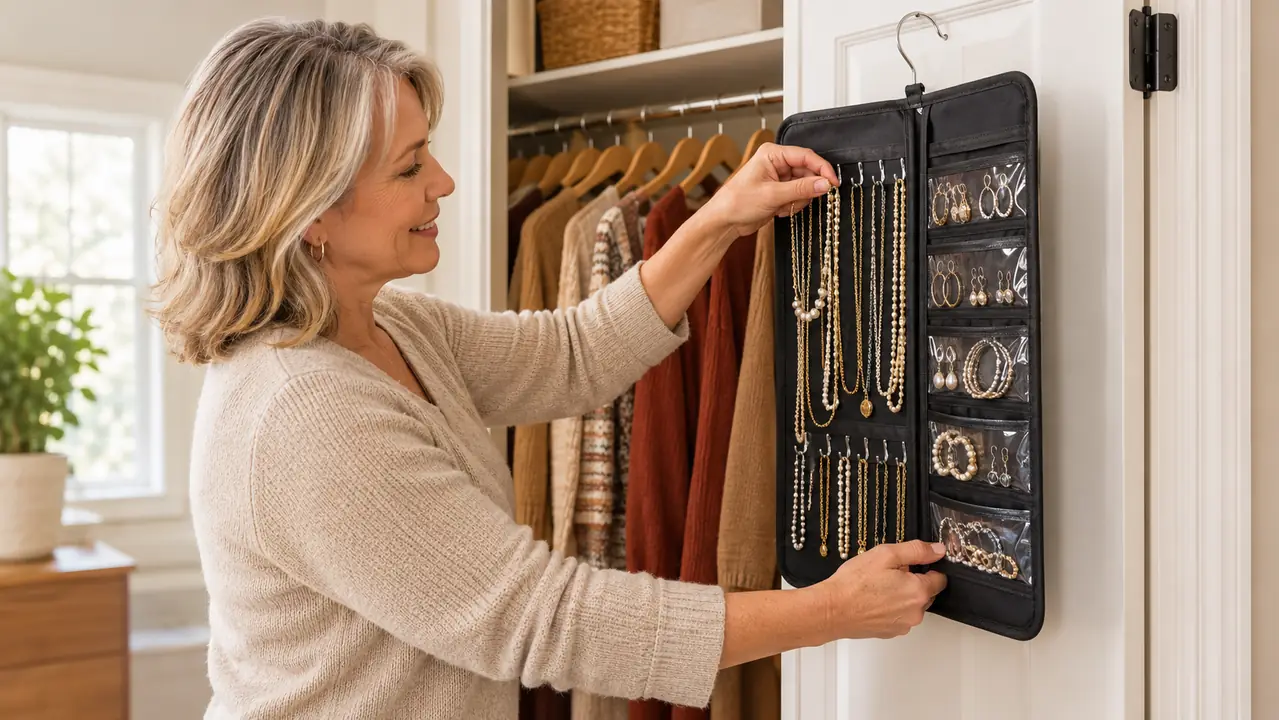
The organizer I use is two-sided, and the hanger rotates a full turn. That sounds like a minor feature until you are standing there at 7:20 in the morning. One turn brings the earring side around without me unhooking anything, and the whole panel weighs 8.8 ounces, so it swings around easily on the hook.
I gave the two faces two jobs. The face I see when the door is open holds everyday: the hoops, the thin chain, the amber beads, the studs I wear to the grocery store. The back face holds occasion: the pearl drops, the long necklace that only works with the teal top, the rings I wear to things with tablecloths. Nineteen months in, that split has held without me having to renegotiate it.
The capacity is genuinely more than I need. The listing gives three rows of wave-shaped metal hooks and says up to 42 necklaces. I hold 28, plus 14 pairs of earrings and 9 rings, and I have never once filled a row. That slack is the point. An organizer that is exactly full becomes a puzzle you have to solve every time you buy a pair of earrings.
Step 4: Hang by How Often You Wear It, Not by Length
Hanging by length looks beautiful and it is a mistake. My first arrangement put the long chains at the bottom, which is what a store does, and the pieces I wear most ended up at hip height where I had to bend to see them. Rehang by frequency. The five things you wear weekly go at eye level, in the middle rows, exactly where your hand already goes without thinking.
Weight is the other half of it. Heavy necklaces pull one side down, and I have watched the whole panel hang crooked after a week of a chunky amber strand sitting on one hook. Now the heavier pieces go toward the center and the light chains go out at the edges, and I check the hanger every Sunday when I do the reset. This is the honest flaw of anything soft-sided that hangs on a door. It hangs. It moves. You adjust it.
It also swings when the door opens. I cannot talk my way out of that one. Ray opens that door with his shoulder on his way down the hall and the whole panel sways. The fix, such as it is, is to open the door by the handle and keep the heavy things distributed, which cuts the swing down to almost nothing in practice.
Step 5: Reset It Once a Month and Fold It When You Travel
The reset takes five minutes and it happens the first Sunday of the month. I take everything off both faces, wipe the panel with a dry cloth, put back only what I wore in the last four weeks, and rehang the rest by frequency. Anything that has gone two resets without being worn goes into the envelope for Elena. That is the entire maintenance plan. There is nothing bigger behind it.
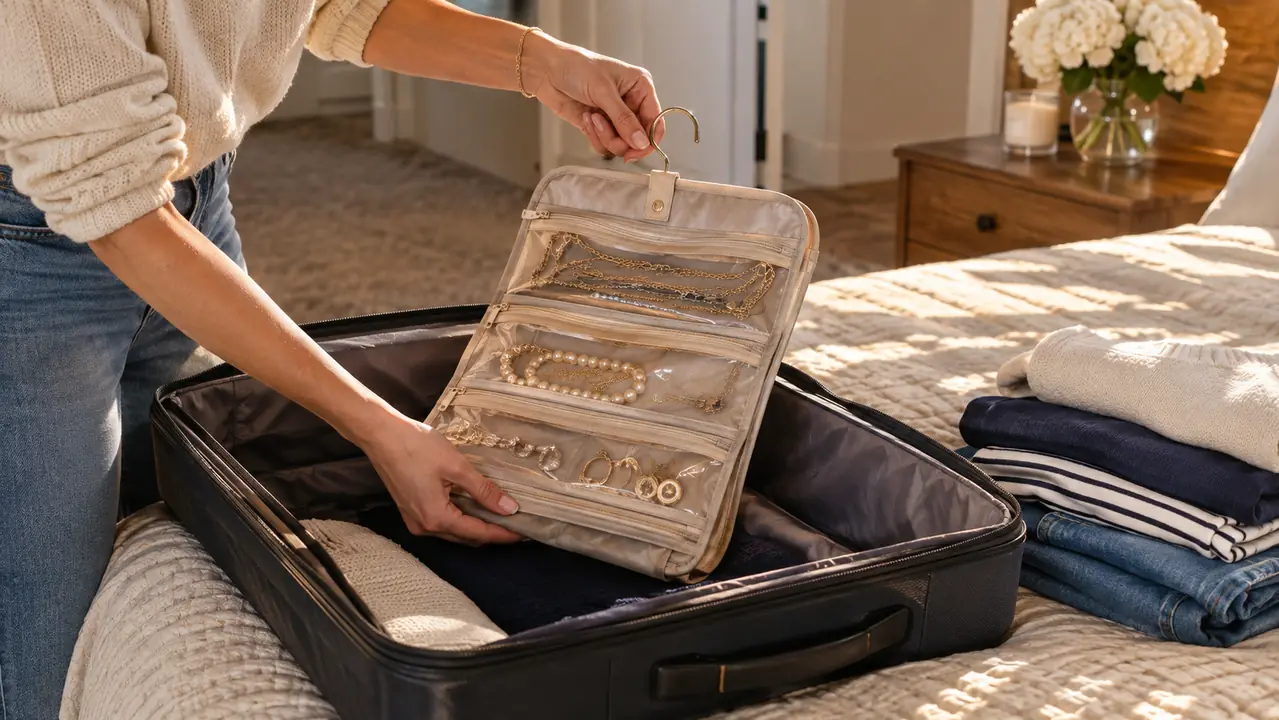
Then there is travel, which is the reason I chose this design over a box on the dresser. It is foldable, and it folds into something small enough to pack. I have folded mine exactly twice, both times on the trip to see my sister in Tucson, and both times I arrived with the necklaces still separated. That is not a small thing. Chains that travel well are chains you actually take with you.
One caution about the fold. Fold it the way it came, hooks facing in and the earring side against itself, or you will spend the first evening of your vacation doing exactly the thing you bought this to avoid. It took me one try to learn that, and I am passing it along so it only takes you none.
What Else Helps
Two other things did as much for this system as the organizer itself. The first is the Zober velvet hangers I bought the same January the clean-out started. Fifty of them, one per hanging piece, and the rod finally sat at an even height so I could read my own color order at a glance. Before that, a mix of wire and tubular plastic hangers of different lengths made the closet look like a hedge.
The second is the six-shelf fabric unit hanging at the right end of my four feet of rod, with tomorrow's outfit set out on the bottom shelf the night before. That is what turned this from an organizing project into a ten-minute morning. You cannot match jewelry to an outfit you have not chosen yet. Choose the outfit at night, and the organizer on the door has something to answer to.
Jewelry sorted by category makes you shop. Jewelry sorted by outfit lets you get dressed.
If you take one thing from this, take the order of the steps. Clear the bed, sort by outfit, put the closet in color order, then hang by frequency. The organizer is the last thing you need and the easiest thing to buy. It is also the reason the first three steps stay done, which is more than I could ever say for the wooden box on my dresser.
Nineteen months on the back of my door, and the chains are still separate
BAGSMART hanging jewelry organizer, size L, two-sided with a 360 degree rotating hanger, three rows of wave-shaped hooks, 8.8 ounces, folds flat for travel. Mine has held 28 necklaces and 14 pairs of earrings without a single tangle I had to cut out.
Amazon Check Today's Price on Amazon →