
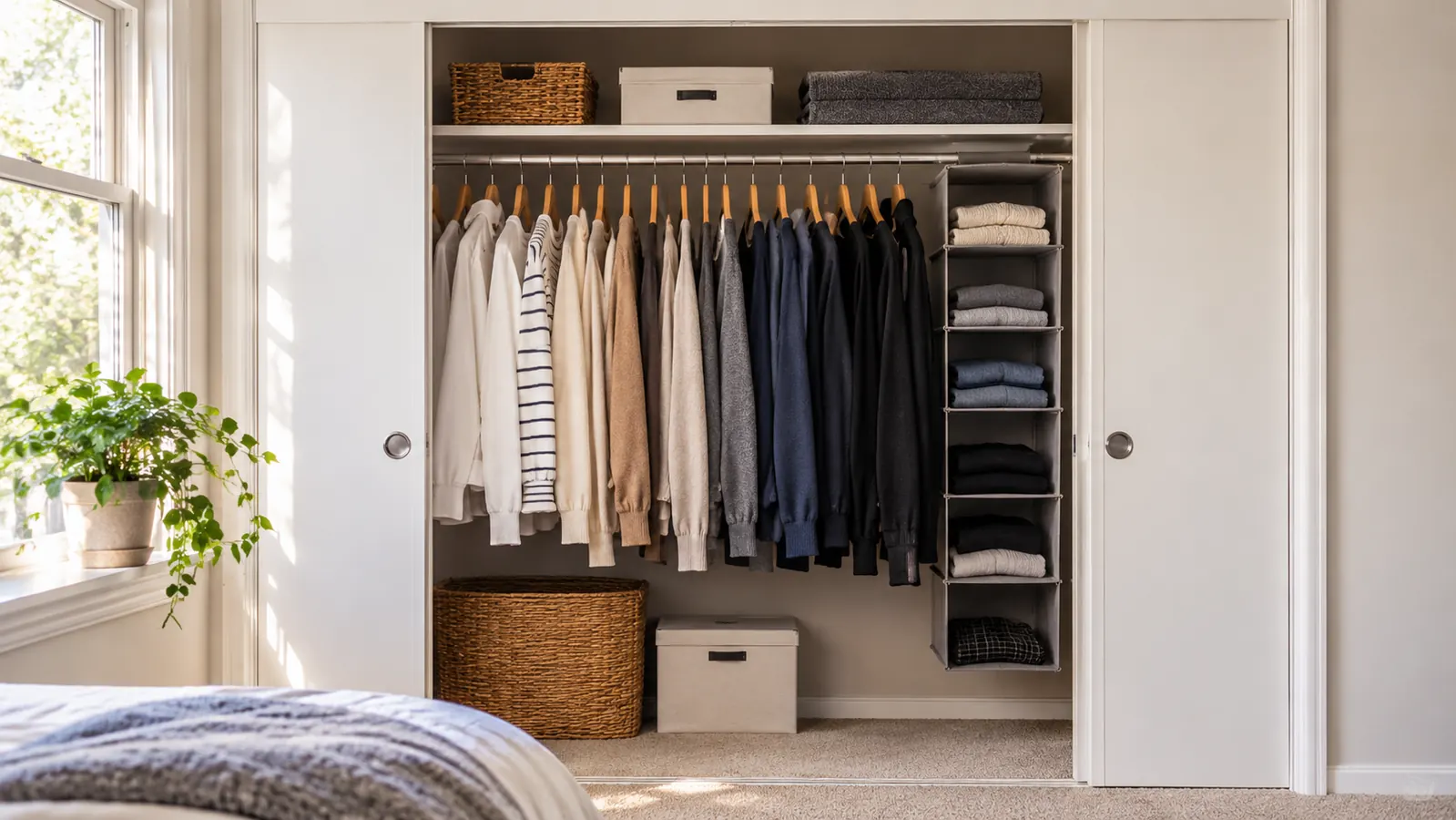
The first time I tried to build a capsule wardrobe, I did it backwards. I picked a number out of thin air, walked to the closet, and tried to argue my clothes down to it. My closet is six feet wide with sliding doors, one rod, and one shelf above. My husband Ray keeps his clothes on the right two feet of the rod, on his own plastic hangers, and he wants no part of this project. That left me four feet of rod and thirty years of teaching clothes. The number was never the problem. The container was.
What finally worked, starting in January 2025, was planning the wardrobe around the container instead of the other way around. I hung a YOUDENOVA six-shelf hanging closet organizer at the right end of my four feet of rod, and the closet got a second job. Folded clothes could live where I could see them, instead of in a drawer where I forgot them. The unit is twelve inches wide and forty-eight inches tall, with six shelves, side pockets, and a twenty-five pound limit. That one piece of fabric and board changed what a capsule could be for me, because it gave the folded half of the wardrobe somewhere to stand.
Four Feet of Rod and Six More Shelves
This is the piece that made my capsule plan fit in a closet that was never going to get bigger. Twelve inches of rod, six shelves, two side pockets, twenty-five pounds. Mine has held folded tees, knits, sweaters, jeans and workout clothes for about twenty-one months.
Amazon Check Today's Price on Amazon →Step 1: Count What You Hang Before You Choose a Number
Before I hung anything, I counted. Every hanging piece on my side of the rod, one at a time, out loud, the way I used to take inventory of paper in the art room. There were more than ninety, which explains a good deal about my mornings in 2024. Then I measured: four feet of rod is forty-eight inches, and the organizer takes the last twelve of them. Fifty hangers is what fit without shoving, so fifty became the number. Not because a book told me. Because the closet did.
That order matters more than any other part of this. If you pick the number first, you spend an entire afternoon negotiating with yourself about a brown skirt you have not worn since 2019. If you let the container pick the number, the decision is already made and the only job left is sorting. Keep the count on a sticky note inside the closet door where you can see it. I still have mine, and it says 50 in pencil with the date underneath it.
The hangers do real work here, so do not skip them. I replaced decades of wire and tubular plastic with one fifty pack of Zober velvet hangers, one per hanging piece, and it helped the same day. The rod looked even and my clothes stopped sliding onto the carpet. Two flaws, honestly. There was a faint black fuzz on one white shirt in the first week only, and the grip is strong enough that a slippery blouse needs two hands. No hanger has broken in twenty-two months.
Step 2: Sort by Color Before You Sort by Category
A color analyst draped me in the spring of 2024 and told me I am a soft autumn. I had heard the phrase before and assumed it was nonsense. Then she held a rust scarf under my chin and I watched my whole face change in the mirror. That is the day this project actually started, and it is why my closet now runs left to right in one fixed order: cream, camel, olive, rust, teal, brown. Six sections, no exceptions, and warm gold tone is the only metal I wear.
Sort by color first and category second. This is the step people skip, and it is the step that shows you what you actually own. When everything olive sits together on the rod, three olive shirts become impossible to ignore. When the same clothes are filed by category, you own one olive shirt and two you never noticed. Color is also how I find things now. I know the teal section is about a quarter of the way along the rod, so I reach for it without reading a single label.
If you have not been draped and have no interest in being, here is the shortcut. Pull out the eight or ten things you genuinely wear, lay them on the bed, and let them tell you the palette. Mine would have named the same six colors the analyst did, and it would have cost me nothing but an afternoon and one load of laundry. The point is not the label. The point is that every piece on the rod can be worn with every other piece, and color is the fastest way to see whether that is true.
Step 3: Hang the Organizer and Give Every Shelf One Job
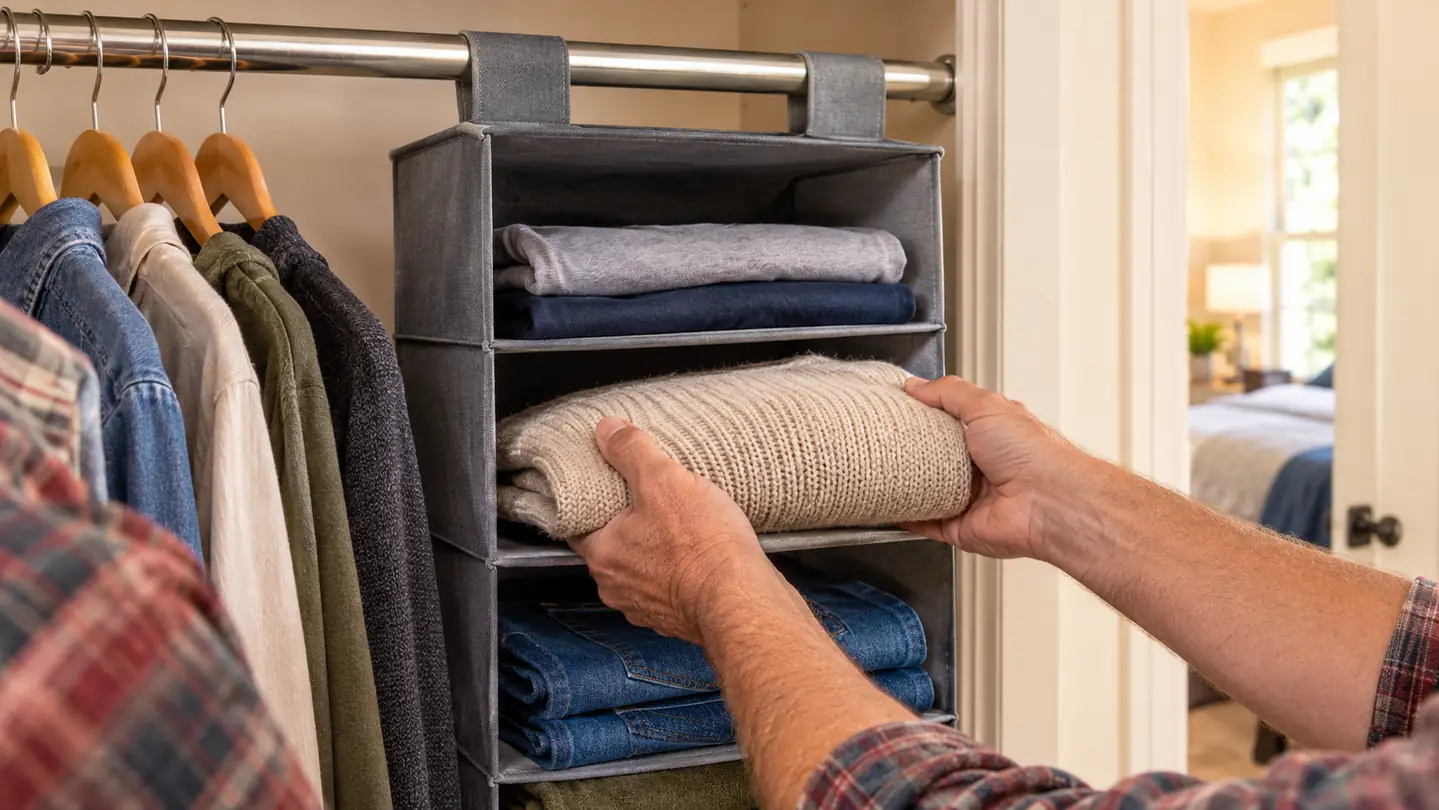
The YOUDENOVA organizer hooks over the rod at the right end of my four feet, about twelve inches wide, and it went up in a couple of minutes with no tools. Each shelf has two bamboo inserts that keep it from folding shut, and there is a rigid board at the top and at the bottom. That structure is the reason it can hold a stack of jeans without turning into a hammock by Thursday. There are side pockets for the small things that otherwise go missing between the dryer and the closet.
Every shelf has exactly one assignment, and I have not changed them in twenty-one months. Top to bottom: tees, light knits, sweaters, jeans, workout clothes, and the bottom shelf for tomorrow's outfit. The side pockets hold socks and folded scarves. When a shelf has one job, you stop making decisions at seven in the morning. You put your hand out and the right thing is already in the right place. That sounds small. It is not small when it happens every single day.
Two honest flaws. The top shelf sags a little if I overload it, so the sweaters live one shelf down and I stay well under the twenty-five pound limit at all times. And the fabric collects dust, which means a wipe down with a damp cloth every couple of months. Neither of those stops it from doing the job. They are just the things I would tell a friend across the kitchen table before she ordered one for herself.
Step 4: Make the Bottom Shelf Tomorrow's Outfit
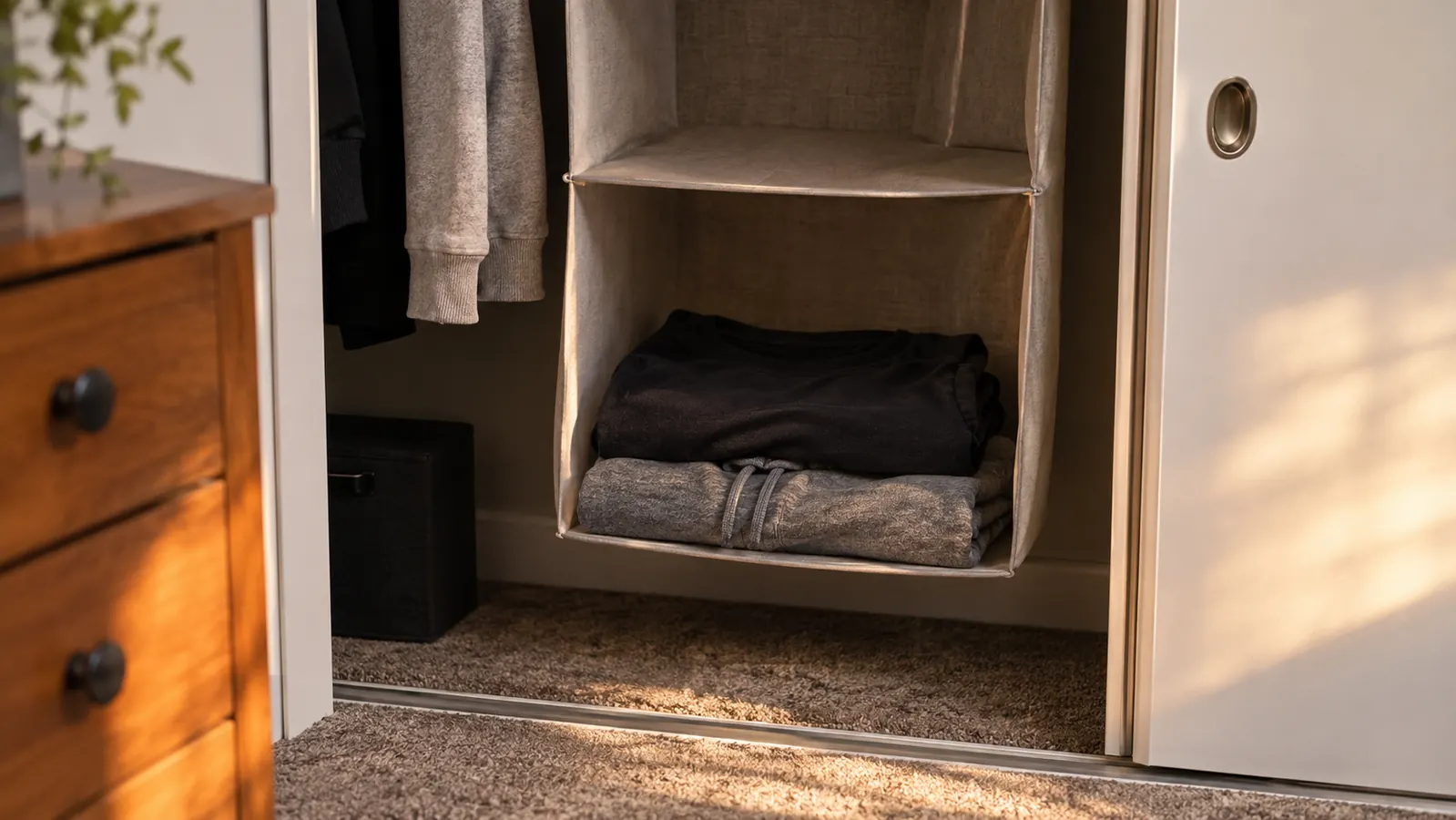
The bottom shelf is the one that changed my mornings. In the last ten minutes before bed, I set out the whole outfit: the top, the bottom, and whatever goes over it. I do it in the bedroom light with the doors open and everything visible, which is a far better time to make that decision than at 7:15 in a dim room with Ray asking whether we are out of coffee. Once the outfit is on the shelf, the morning conversation with my closet is over before it starts.
By spring 2025 I had gone from about twenty minutes of standing in front of the closet to about ten, and most of that gain came from a single shelf holding a decision I had already made. Some of the rest came from the color order, because a top that works with a bottom usually lives in the same neighborhood on the rod. Ten minutes back every morning is not dramatic. It is just quietly better, and it compounds in a way that a new sweater never does.
I went from twenty minutes in front of the closet to ten, and most of that came from one shelf holding a decision I had already made.
Step 5: Hold the Line With One In, One Out and Two Rotations a Year
The rule since the clean-out has been one in, one out. I do not get to add a cream blouse without taking a cream blouse off the rod the same week. Fifty works because fifty is visible. When the number was ninety-something, nothing was visible and I could always find room for one more. Now room is a physical thing I can see from the doorway, and that is what makes the rule hold when a catalog arrives in the mail.
Twice a year, in April and October, I rotate. Off-season clothes come off the organizer and go into under-bed bags, and last season's come back out and onto the shelves. April 2025 was the first rotation and October 2026 was the fourth. The shelves thin out in April, which is fine. It gives the knits breathing room and it gives me an honest look at what I did not wear all winter, which is usually two things I should have let go in October.
If the closet drifts, and mine drifts around the holidays, go back to step one and count. It takes ten minutes and it resets everything. I have done that three times in twenty-two months, and every time the answer was the same: five pieces had crept in through the side door. A capsule wardrobe is not a one-time project. It is a small habit with a rod and six shelves attached to it.
What Else Helps
The YOUDENOVA organizer solved the folded half of the problem, but three other things did the rest. Velvet hangers, covered above, are the first. The second is a place for off-season clothes that is out from underfoot. I use four under-bed bags, each about thirty-nine by twenty by seven inches, two per side under the queen bed. They are soft sided, they sit on carpet, they are not water resistant, and they collect a little dust. I tried vacuum bags for one winter and stopped, because my sweaters came out creased and stayed that way.
The third is a home for the small things that used to creep into the closet and take it over. My makeup lives in a clear seven-drawer organizer on the left side of the desk by the bedroom window, where I can check color in daylight instead of under a bulb. My jewelry hangs on a two-sided organizer on a hook on the back of the door, which ended the tangling and also ended the pile on the dresser. Neither one belongs in a closet, and that is exactly the point. A closet works better when it only has to be a closet.
One more thing worth saying plainly. Do not buy storage before you have done the count. I did it in the wrong order for years, and I ended up with containers that held things I did not want, in a room I did not enjoy standing in. The count comes first, then the container that fits the count. If you have one rod and a shelf above it, that container is probably a hanging organizer. If you have a walk-in with floor space to spare, it might be something else entirely, and that is fine too.
Start With the Container, Not the Number
If your closet has one rod and no room to grow, the YOUDENOVA hanging organizer puts six shelves in twelve inches of rod. Mine has carried tees, knits, sweaters, jeans and workout clothes for about twenty-one months. The only thing I still watch is the weight on the top shelf.
Amazon Check Today's Price on Amazon →