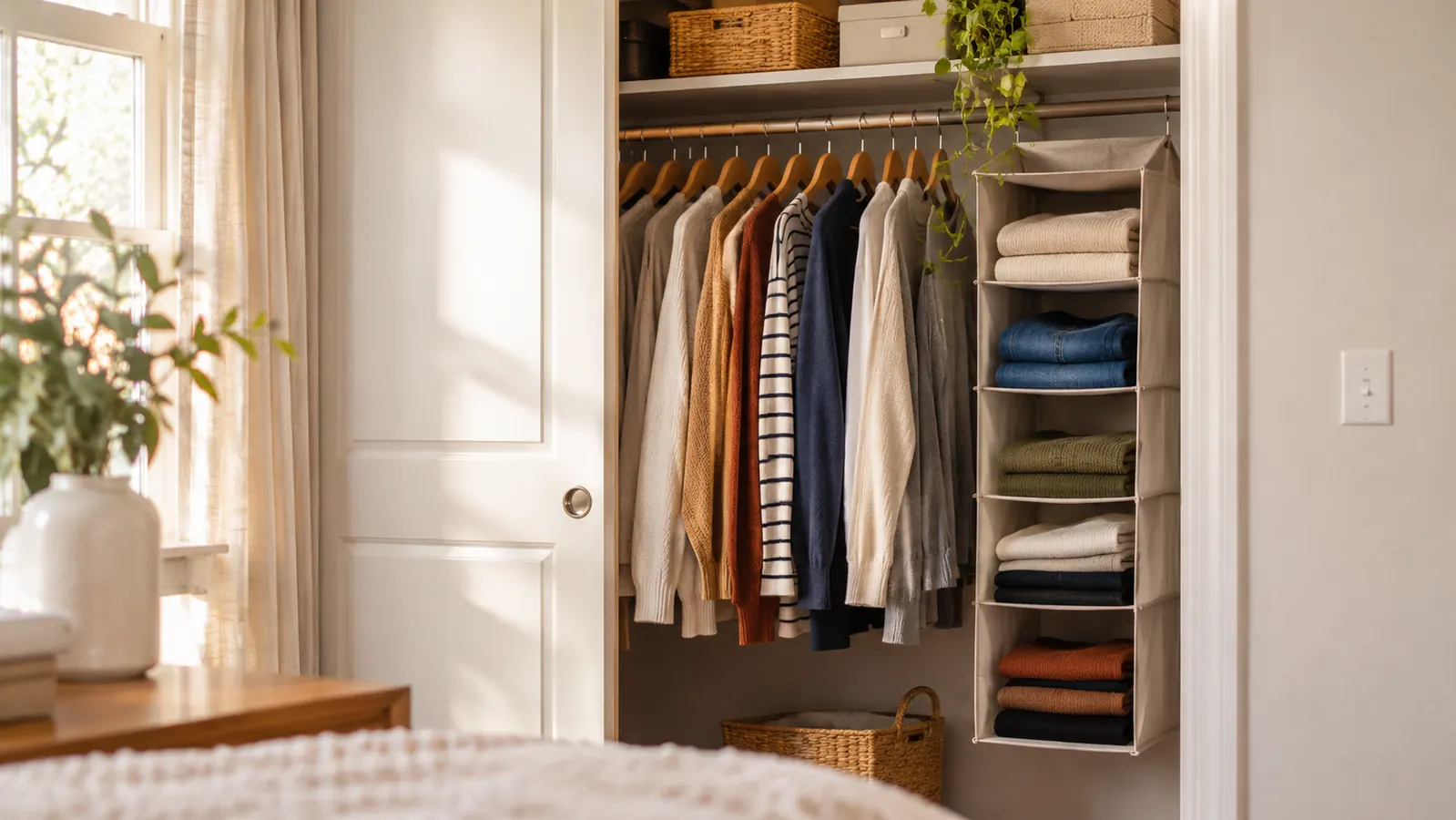
The honest thing about a hanging closet organizer is that it does not give you more closet. It gives you more shelf. Those are two different problems, and for most of my adult life I treated them as the same one, which is why I owned bins I could not reach and stacked sweaters on a top shelf above a rod I could not see past.
My name is Miriam Sandoval. I taught high school art for 26 years and retired in June 2024, and in January 2025 I pulled every piece of clothing out of my one reach-in bedroom closet and laid it across the queen bed to start over. The YOUDENOVA 6-Shelf Hanging Closet Organizer came into that project in late January 2025, a couple of weeks after the hangers. I have used it nearly every day since, about 21 months now, and what follows is the list of things I would want a friend to tell me before I hung one.
The Quick Verdict
A sturdy six-cubby unit that turns dead rod space into shelving you can actually see. It dips if you overload the top shelf, the fabric gathers dust, and the 25 pound limit arrives faster than you think.
Amazon Check Today's Price →Six piles of folded clothes in twelve inches of rod
The YOUDENOVA turns a stretch of rod you were not using into shelving you can see at a glance. Load it sensibly and it holds. Treat it like a dresser and the top shelf will tell on you.
Amazon Check Today's Price on Amazon →What Nobody Tells You About a Hanging Organizer
The product photos make it look like a chest of drawers that happens to hang. It is not. It is a soft-sided column of six cubbies, 48 inches tall and about 12 inches deep by 12 inches wide, suspended from your closet rod by a strap. That is the entire design, and it is a good design, but it means everything you put in it pulls on one strap and one rod.
Two build details are better than the versions that show up next to it in a search. Each shelf has two rigid bamboo inserts, and the top and bottom of the unit are MDF board rather than fabric alone. What that buys you is a shelf that stays flat under a stack of jeans instead of curling at the corners like a hammock. It does not make the shelf as stiff as a wooden shelf. It makes it flat, which is most of what you need.
The detail that never makes the listing headline is the weight limit. Twenty-five pounds is the maximum for the whole unit, not per shelf. Spread across six shelves that is a little over four pounds apiece, and four pounds of folded sweaters is two sweaters. I put stacks on the kitchen scale now and then, which sounds fussier than it is, and I stay well under the limit. If you were planning to park a winter coat collection in one of these, plan differently.
It also hangs low. Forty-eight inches of unit dropping from the rod puts the bottom shelf close to the floor in a standard reach-in. In mine it clears by a couple of inches. Measure from your rod down to the floor before you order, because a high rod and a low rod are not the same purchase.
One more dimension that matters if you have sliding doors: the unit is 12 inches deep, and my doors need a few inches of clearance to travel. Twelve plus that clearance works in my closet. If yours is shallower, check the door track before you order, because an organizer that blocks the door is worse than no organizer.
How I Have Actually Used It
My closet is 6 feet wide with sliding doors, one rod, and one shelf above the rod. Ray has the right 2 feet of that rod and keeps his clothes on his own plastic hangers. I have never touched his side and he has never touched mine. My four feet start at the left wall.
I hung the YOUDENOVA at the right end of my four feet, next to Ray's shirts, where it takes roughly 12 inches of rod. That leaves me about 3 feet of hanging space for the 50 pieces I cut down to, which sounds like a downgrade until you see what the 12 inches gives back.
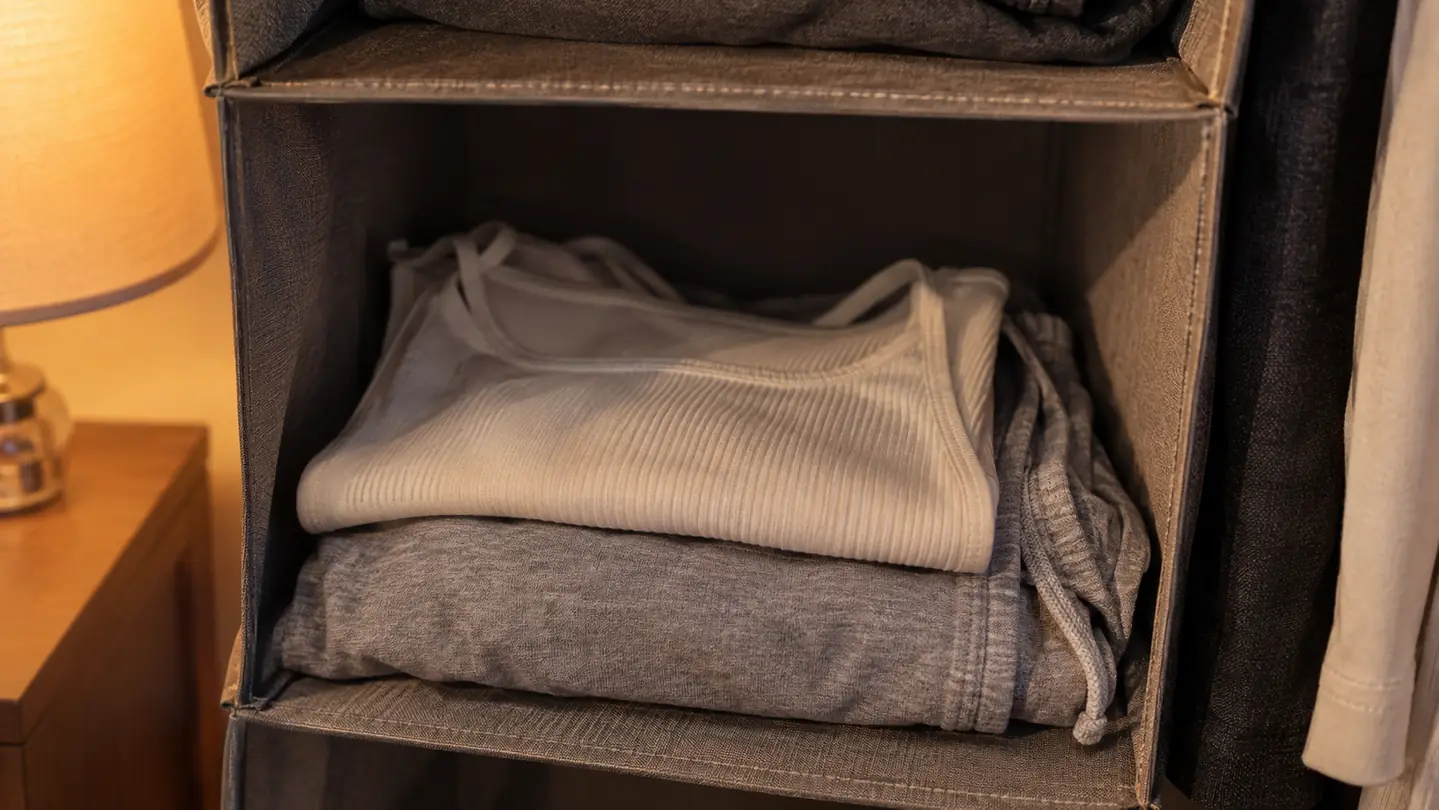
Top to bottom, this is what lives in it. Shelf one, tee shirts. Shelf two, light knits. Shelf three, sweaters. Shelf four, jeans. Shelf five, workout clothes. Shelf six, the outfit I am wearing tomorrow, set out the night before. The side pockets hold socks on one side and folded scarves on the other, and those pockets are the reason socks stopped migrating to the bottom of a drawer.
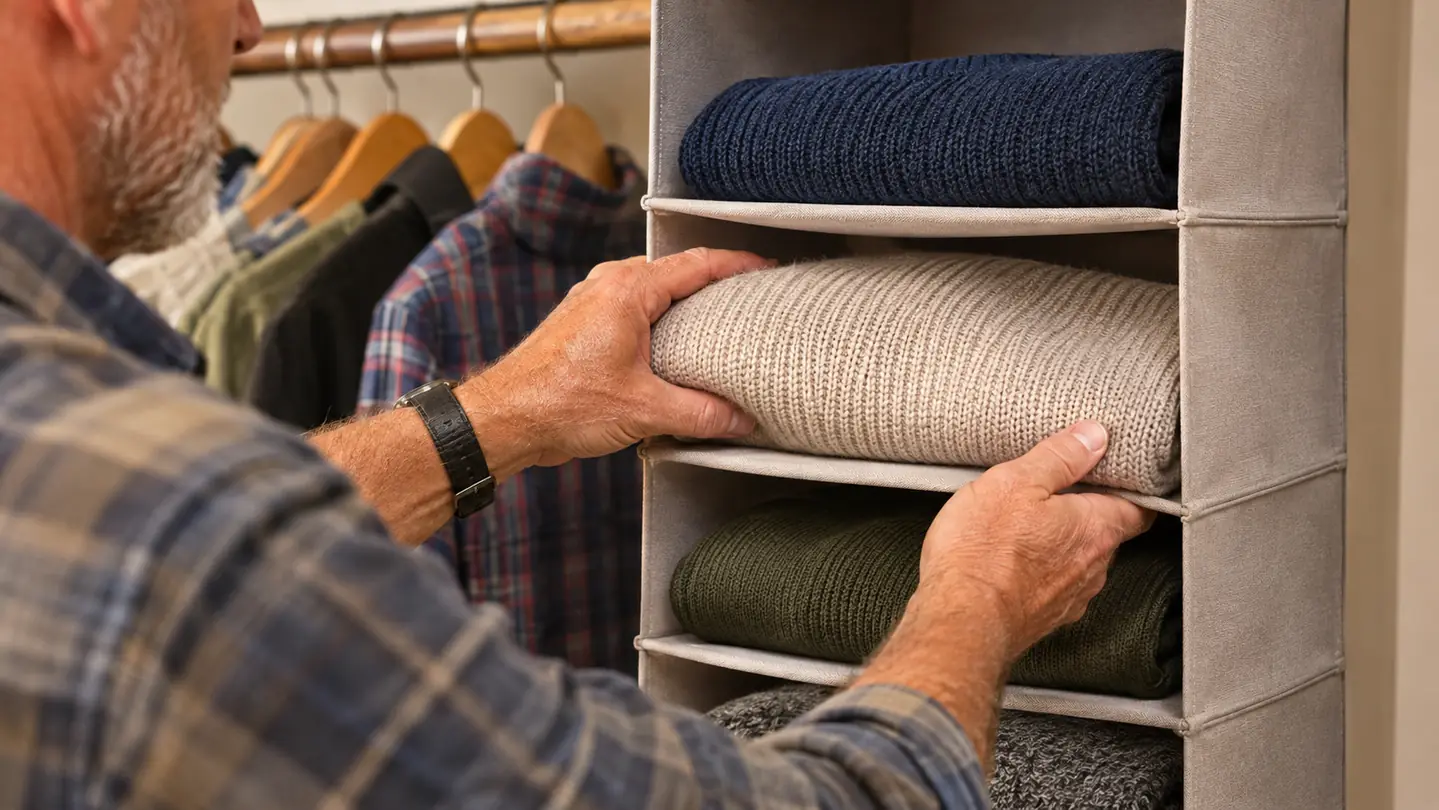
How much actually fits on a shelf is worth spelling out. One shelf takes a stack of about eight tee shirts, or four sweaters, or two pairs of jeans folded in thirds, and I get two piles side by side on most shelves. That is not a dresser's worth of clothes. It is six days of outfits plus a workout set, which was the exact gap I was trying to close.
It helped within the first weekend. That is not a figure of speech. By Sunday night the tees were out of the plastic bin and onto a shelf at eye level, and the bin went to the hall closet for something else.
The Sag Question, Answered Honestly
The top shelf dips a little if I overload it. Not dramatically, no tear, just a soft sag in the middle that I can see from the doorway. I caused it in the first month by putting four sweaters up there instead of two. I moved the extras down to shelf three and the dip mostly came back out, though if I look closely I can still find the ghost of it.
The bamboo inserts are what keep that from becoming permanent. Without them the fabric would stretch and stay stretched. With them the shelf bends and recovers, and the bend is your warning that you have gone past a sensible load. Think of it as a built-in gauge rather than a defect.
The MDF boards at the top and bottom do a similar job. The bottom board especially, because a full bottom shelf of anything heavy would otherwise pull the whole column out of shape. It has held up through 21 months of jeans and tomorrow's outfits without any change I can detect.
What I would tell you is to put the light things high. Tees and light knits on shelves one and two, sweaters and jeans lower down, where the load has more fabric beneath it to spread across.
Dust, Pockets, and the Small Annoyances
The fabric collects dust. This is the flaw I notice most and there is no clever fix for it. Once a month I run the brush attachment of the vacuum over the front and sides, at the same time I do the baseboards, and that keeps it from getting noticeable. If dust bothers you, or you keep windows open all summer, budget for that chore.
The side pockets are smaller than the photos suggest. They hold socks and folded scarves well. A rolled belt fits. Anything wider than a paperback does not, so do not plan on them for gloves in bulk.
The strap goes over the rod with no hardware, which is why it took me about two minutes to hang. It also means the unit can creep along the rod if you shove things in and out hard. Mine has drifted maybe an inch to the left over 21 months. I slide it back when I notice.
None of that is a reason to skip it. All of it is a reason to know what you are buying, which is a shelf you hang rather than a shelf you build.
It does not make your closet bigger. It makes the lower half of your closet usable, and for me those turned out to be the same thing.
What It Changed About My Mornings
The number I can point to is this. Getting dressed took me about 20 minutes before the clean-out. By spring 2025 it was taking about 10. Nothing else in the project moved that number as much as being able to see six prepared stacks at once.
Part of that is the shelf count. Part of it is the bottom shelf. Setting tomorrow's outfit out the night before is not a habit I would have predicted. I do it now because the shelf is right there and empty, and mornings are easier when the decision is already made.
The rest is order. A color analyst draped me in spring 2024 and told me I am a soft autumn, which started this whole project. My hanging clothes run left to right in a fixed order: cream, camel, olive, rust, teal, brown. The folded clothes in the organizer follow the same logic, warm and light up top, dark and heavy at the bottom. Nobody needs this rule. It does mean I can find a rust cardigan without moving anything.
Ray noticed without being told, which for Ray counts as a significant review. He keeps his own clothes on the right 2 feet and has no interest in my projects, but he said the closet looked less like a storage unit. He was right.
Why I Did Not Buy a Shelving Tower Instead
I measured for a freestanding closet shelving tower before I bought this, because a tower sounded sturdier and I like sturdy. The tape said no. My closet is 6 feet wide with sliding doors and a rod running the full width, and a tower would have stood in front of the clothes and blocked the reach to Ray's side.
My sister Elena has a tower in her closet in Tucson and she likes it. Her closet is deeper than mine and she has a shelf she never uses. That is the honest comparison. A tower is the right answer for a deep closet with dead floor space. A hanging organizer is the right answer for a reach-in where the floor belongs to your feet and the rod is already there.
One thing I did not expect: the unit is lighter than the clothes. It weighs less than a pound, so I repositioned it along the rod with one hand while holding a stack of sweaters in the other. A tower does not do that.
I have never owned a tower, so I am not going to pretend I can review one. I can tell you I measured, rejected it on dimensions, and the hanging unit has done the job I wanted it for.
What I Liked
- Two bamboo inserts per shelf keep the shelves flat under a real stack of clothes
- Six cubbies in about 12 inches of rod, space you were not using for hanging anyway
- Side pockets that finally keep socks and scarves out of the bottom of a drawer
- Hangs in about two minutes with no hardware, and folds flat when you move
- Still in daily service after 21 months with no tear and no broken parts
Where It Falls Short
- 25 pounds total, not per shelf, and that runs out faster than you expect
- The top shelf dips if you overload it
- The fabric gathers dust and needs a monthly vacuum
- 48 inches tall puts the bottom shelf low in a standard reach-in closet
- Side pockets are small, fine for socks and scarves and little else
Who This Is For
This is for you if you have a reach-in closet with a rod, a shelf above it, and floor space that belongs to your feet rather than your things. If your rod is full and your shelves are not, this converts one into the other, which is the whole trick.
It is also for anyone setting up a first closet in a small space. The listing names dorm rooms, dressing rooms and kids rooms alongside bedrooms, and that reads right to me. It is light, it folds, it hangs on whatever rod is there, and it comes off the rod in seconds when you move.
And it is for anyone who folds their clothes and then cannot see the folded clothes. Six open cubbies solve something drawers do not, because you can see all six at once without opening anything.
I will say it plainly for the person who is where I was in January 2025: you do not need to redo your whole closet to fix this. One unit, hung at one end, moved the project forward more than the bins and the folding ever did.
I would add one condition. This suits someone willing to keep the load sensible. If you want to fill a shelf and forget it, get something with wooden shelves and a frame.
Who Should Skip It
Skip it if your closet has no rod, or the rod is a wire shelf with nothing to hang from, or the rod flexes when you pull on it. All of the weight goes through one strap, and a rod that cannot take a hanging sweater stack will not like this.
Skip it if you need to store coats, bedding or anything heavy. Twenty-five pounds for the whole unit sounds generous until you start weighing what you meant to put in it.
Skip it if you have a deep closet with unused floor space and you were already considering a shelving tower. Elena's tower would not fit my closet and mine would not do her job. Both are fine, and buying the wrong one for your dimensions is the only real mistake here.
And skip it if dust is a serious problem in your bedroom and you are not going to vacuum fabric once a month. The unit is fabric. It will collect.
Measure your rod to the floor, then decide
If your rod is full and your floor belongs to your feet, the YOUDENOVA gives you six cubbies in twelve inches of rod and holds up as long as you respect the 25 pound limit. That is the whole pitch, and it is an honest one.
Amazon Check Today's Price on Amazon →