
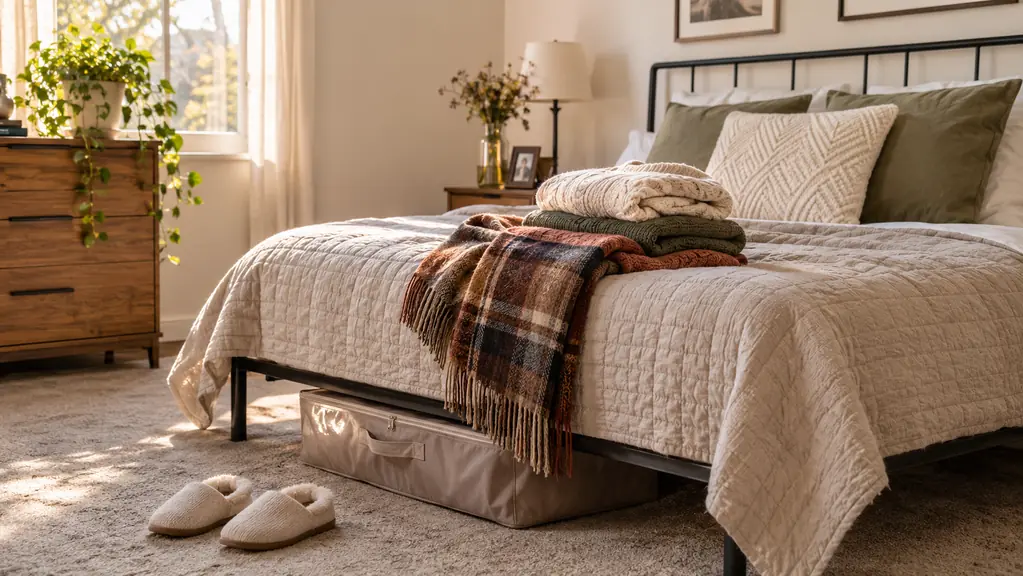
The reviews for the Budding Joy under bed storage containers are, on the whole, accurate. They hold more than you expect them to. They slide under a queen bed with room to spare. Thousands of people have said so and I am not going to argue with them. What those reviews leave out is the part that decides whether you are still using the bags two years later, which is how one behaves the fourth time you drag it across a carpeted floor at seven in the morning while your coffee goes cold.
I bought the four pack in February 2025. It is November 2026 as I write this, so I have owned them about twenty-one months and rotated them four times, in April and October of each year, two bags per side of the bed. This is what I would want a friend to tell me across the kitchen table before she spends an afternoon on her knees.
The Quick Verdict
Roomy, light and genuinely useful for a season of clothes. Also soft sided, not water resistant and not stackable. Know that going in and they will serve you well.
Amazon Check Today's Price →The four pack that finally got my winter sweaters off the closet shelf
These are the bags I have rotated four times since February 2025. Each one is 39 by 20 by 7 inches, with a clear top window and a zipper closure. No assembly, nothing to snap together, and they fold flat when the season turns.
Amazon See the Budding Joy 4 pack on Amazon →What Arrived, and What the Numbers Mean
Four bags arrived folded flat in a box. No assembly, nothing to snap together, no instructions worth reading. Unfolded, the listing gives each one as 39 inches long, 20 inches wide and 7 inches deep. The title says 95 liters. The bullet points say a 90 liter load, which they translate as 24 gallons. That is a small disagreement between two lines of the same listing, and I mention it because I would rather know.
A number on a page never tells you whether your own sweaters will fit, so here is what actually went in. Bags one and two hold my off-season clothes: linens and light cottons from May to October, wool and heavier knits from November to April. Bag three holds off-season scarves, a folded sun hat, two belts and a small cloth pouch of summer jewelry. Bag four holds a spare quilt that used to live on the top closet shelf where I could not reach it without the step stool.
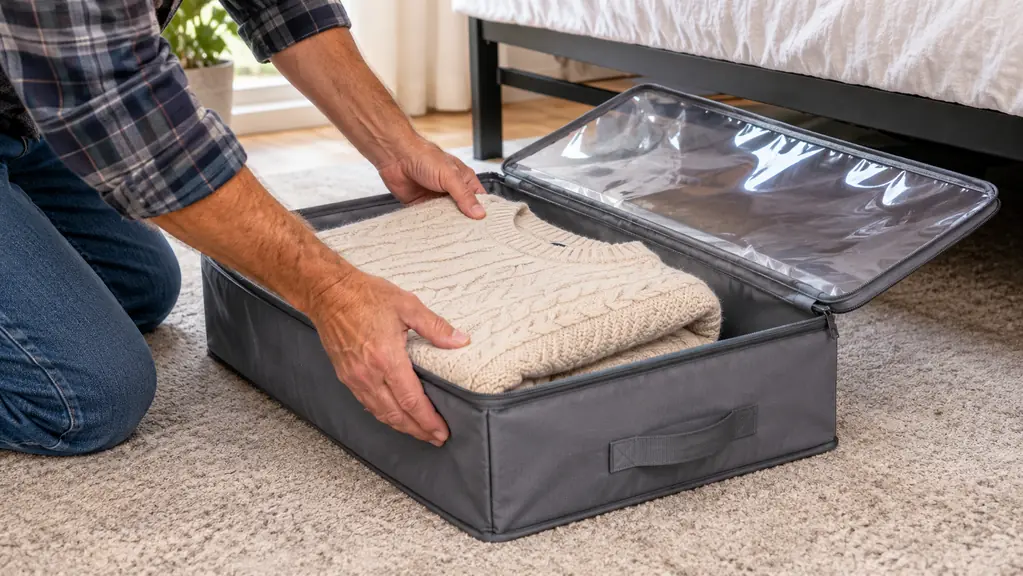
The material is listed as a three-ply composite non-woven, which is a plain way of saying thick fabric with a stiffened middle layer. It has enough body to hold its shape while you are filling it and not enough to stand up on its own when empty. The clear PVC window is sewn into the top. The closure is a zipper. Water resistance level: not water resistant, which the listing states plainly and I respect.
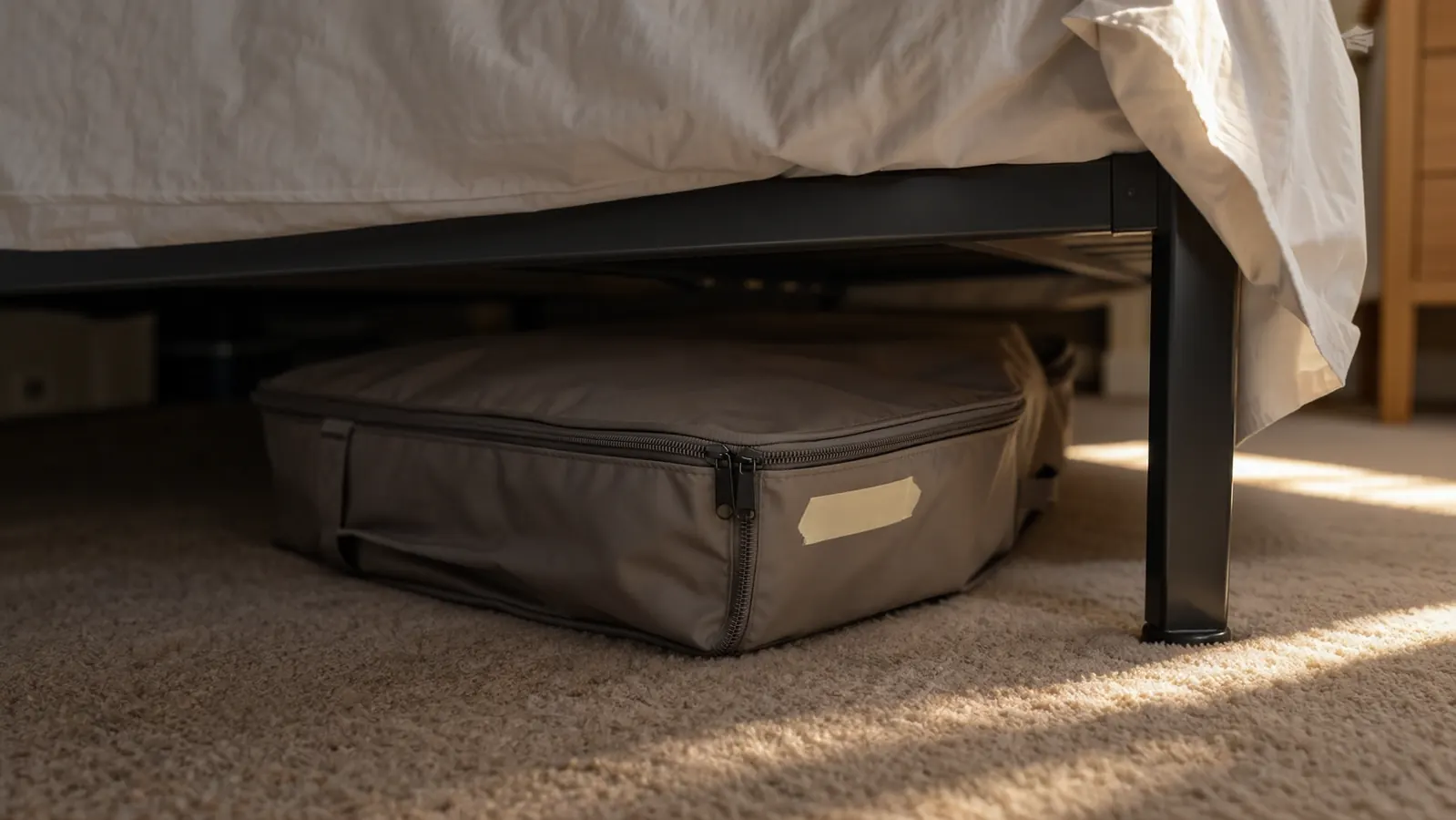
My bed sits on a metal frame with nine inches of clearance and the bags are seven inches deep, so there are two inches of margin. Two inches is enough. It stops being enough the moment you overfill, and overfilling is the most common way people end up disappointed with a bag like this. I know because I did it once.
I measured before I ordered, and I want to be honest about how that went. I took a tape measure to the gap under the frame on a Tuesday morning and got nine inches at the corner nearest the window and closer to eight and a half in the middle, because the carpet has a dip there from thirty years of feet. The bags are seven inches. So the margin is real but it is not generous, and if your frame sits lower than mine I would measure twice before ordering. The other number I checked was the bedroom door at 30 inches against the bag at 39 inches long. That sounds like nothing until you decide to store the bags on a closet shelf between seasons, and then it is the number that decides the whole plan.
Twenty-One Months, Four Rotations
The first rotation, April 2025, was the test. I took the winter things off my four feet of rod, folded them the way you fold for a shelf rather than the way you fold for a drawer, and laid them in flat instead of stuffing. Both bags zipped without a fight. I pushed them under the bed on my hands and knees and they went in on the first try, which sounds like a small thing and is not, because a bag that has to be shoved is a bag that ends up staying out.
The second rotation, October 2025, is the one that told me the bags would last. Nothing had torn. The zippers still ran. The contents smelled like the contents and not like a closet, which was my worry with fabric instead of plastic. What had changed was the outside: the tops had a film of dust and the fabric had picked up fuzz from the carpet. I wiped them with a damp cloth, let them dry on the porch rail, and refilled them that afternoon.
The third and fourth rotations, April and October of 2026, took about twenty minutes each. That is the part I did not expect. The system turned out to be worth more than the bag. Because I pack the same four bags the same way every time, I know that bag one is summer and bag two is winter without opening either one, and I never stand in front of an open bag deciding where something belongs.
The October 2026 rotation is recent enough that I remember the morning clearly. I started at nine on a Saturday, pulled all four Budding Joy bags out into the middle of the floor, and worked backward from the quilt so the bulkiest thing went in last. Bag four had a corner of quilt showing through the fabric at the seam. Not torn, just stretched, and I moved it in an inch and it has been fine since. Ray walked past twice and did not offer to help, which is fair, because his two feet of rod on the right side have never caused him a moment of trouble. I was finished and had everything back under the bed before ten.
What does not go in them: winter coats, which live in the hall closet and always have, and boots, which are too heavy and would crush whatever they sat on. My four bags are for soft goods only. That is a limitation of the material and not a complaint about it, but it does mean four bags are not four totes and you should not plan on them that way.
Two inches of clearance under the bed sounds like plenty. It is plenty right up until you add two more sweaters.
Between these and a rigid under bed tote, the honest answer is that the tote holds more and stacks. It also takes the same footprint whether it is full or empty, the lid is one more thing to keep track of, and it does not fold away in July. I own the fabric bags. If I had a shelf in a garage I would own totes as well, and both of those things can be true.
The Parts Nobody Puts in the Reviews
The window is on top, and when a bag is under a bed you are looking at its side. To read the window you have to pull the bag out. That is not a design flaw, since there is nowhere else to put a window on a bag this shape, but it does mean the feature does less for you than the product photos suggest. I put a strip of masking tape on the zipper end of each bag with a word written on it. That takes ten seconds and does everything the window was meant to do.
They are soft sided, so they do not stack. If your under bed space is deep enough for two layers, these are the wrong choice. Mine is one layer, two per side, and that is the whole of my under bed storage. I would rather say that plainly than have you order four and find out on a Saturday afternoon.
They are not water resistant. My bedroom is carpeted, the bed is nowhere near a bathroom, and the floor stays dry, so this has not mattered to me once in twenty-one months. It would matter in a basement, in a garage, against an outside wall that sweats, or anywhere a pet has accidents. Fabric wicks, and a quilt that has taken on a smell is a long road back to neutral.
Here is the thing that surprised me most, and it is not a complaint. Fabric breathes. I had assumed anything sealed up for six months would come out smelling like the inside of a suitcase, and that has not happened once in four rotations. The wool went in smelling like wool and came out the same. What that same breathability means is that dust and carpet fuzz come in too, which is the other half of the trade. I would take it again. A sweater that smells faintly of the closet is a sweater I have to wash before I wear it, and washing wool is its own afternoon.
The fabric collects dust, the way anything fabric that lives on a floor will. Twice a year I wipe the tops. The zipper is the part I watch, and I brace the bag against my knee to start the zip rather than pulling it in mid air. After four rotations it still runs clean and I have not had to coax a single slider back onto its track. That is the whole of my maintenance routine.
One more thing that never makes it into the reviews: a half empty bag does not slide evenly. It slumps and drags on one corner. The fix is to pack it full or leave it out, and since I only own four bags and have two seasons, mine are always full. If you are the kind of person who stores three things in a bag and puts it away, a rigid tote will annoy you less.
What They Are Not
They are not a tote. There is no frame and nothing rigid about them, and if you want to stack three in a garage, buy a tote.
They are not for anything you need once a week. Anything that lives under a bed and gets opened regularly becomes a chore no matter how good the container is. My rule is twice a year, April and October, and everything in the four bags is something I genuinely do not need in between. If a sweater is in bag two in January, it stays there until April, and I have made my peace with that.
And they are not vacuum bags, which is the comparison people ask about most. I used a set of vacuum bags for one winter, 2023 into 2024, in the hall closet, and I stopped. They held a great deal and they sealed fine at first. My sweaters came out creased along the fold lines and stayed creased until they were washed, and one bag had lost its seal by March. The Budding Joy bags take more room and compress nothing, but what comes out in October is what went in in April. That trade is worth it to me.
What I Would Change
Two things, and neither is a deal breaker. I would put a second window on the long side, so a person on her knees could read it without pulling the bag out. And I would stiffen the bottom a little, which would help the half empty slump and make the bag easier to push across carpet. Those are wishes, not flaws. At this size and this weight they are the sort of thing you notice in year two and then shrug at.
I would also buy the four pack again rather than two sets of two. Four is the number that matches my closet: two bags of clothes, one of accessories, one for the quilt. If you have a king bed or a second closet, four may be one short. If you have a twin bed in a guest room, four is more than you need and a smaller set makes more sense.
The line about water resistance deserves one more sentence than I gave it earlier, because it is the line most people skim past. Non-woven fabric holds a spill against whatever is inside it rather than shedding it, and unlike a hard bin there is no raised lip to stop a puddle reaching the seam. I keep mine on dry carpet in a bedroom with a door, which is the easiest case there is. If your under bed space is anywhere water has ever been, a rigid tote with a lid is the honest recommendation, and I would say the same thing about my own four bags.
What I Liked
- Each bag is 39 by 20 by 7 inches, and two bags swallowed a full season of my clothes
- No assembly and they fold flat between seasons
- All four zippers still ran clean after four rotations across twenty-one months
- Light enough to drag out from under a queen bed with one hand
- The fabric breathes, so nothing came out smelling like a closed-up closet
Where It Falls Short
- The clear window is sewn into the top, so you cannot read it while the bag is under the bed
- Water resistance level is listed as not water resistant, and fabric will hold a spill against the contents
- Soft sided, so they do not stack, and a half empty bag slumps and drags on one corner
- The fabric collects dust and carpet fuzz and wants a wipe twice a year
- The title says 95 liters while the bullet points say a 90 liter load, so the capacity figure is a little unclear
Who This Is For
This is for you if you have a bed with real clearance underneath, a floor that stays dry, one season of clothes that has to go somewhere, and no basement to send it to. It is for a reach-in closet with one rod and one shelf where the shelf is already full, which is my situation exactly: six feet wide, sliding doors, my four feet of rod on the left. And it is for someone who would rather repeat a simple system twice a year than hold out for a perfect one she never gets around to setting up.
It is also for the woman who has already tried the alternative. If your sweaters have spent a winter in a vacuum bag and come out flattened along the fold lines, the Budding Joy bags are the calmer choice, even though they take up more room. Room I had. Creases I did not want to iron out of a good wool sweater for the rest of its life.
Who Should Skip It
Skip it if your storage is in a basement, a garage, a shed or against a wall that gets damp, because these are not water resistant and careful packing does not change that. Skip it if you need to stack, or if your under bed space is deeper than seven inches and you intend to use all of it. Skip it for books, tools or shoes with weight to them, since the sides are soft and will bulge. And skip it if you want to see what is inside without pulling the bag out, because the window faces up and you will be looking at the side.
If the closet shelf is full and the floor is dry, start with four
Twenty-one months, four rotations, two bags per side of a queen bed. Each one is 39 by 20 by 7 inches with a clear top window and a zipper closure, and they fold flat between seasons.
Amazon Check the Budding Joy 4 pack on Amazon →